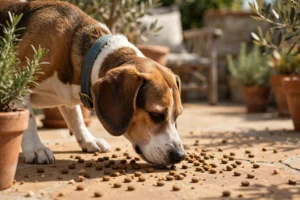
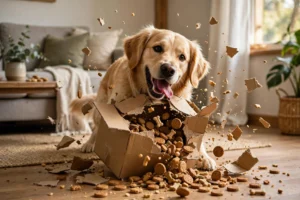
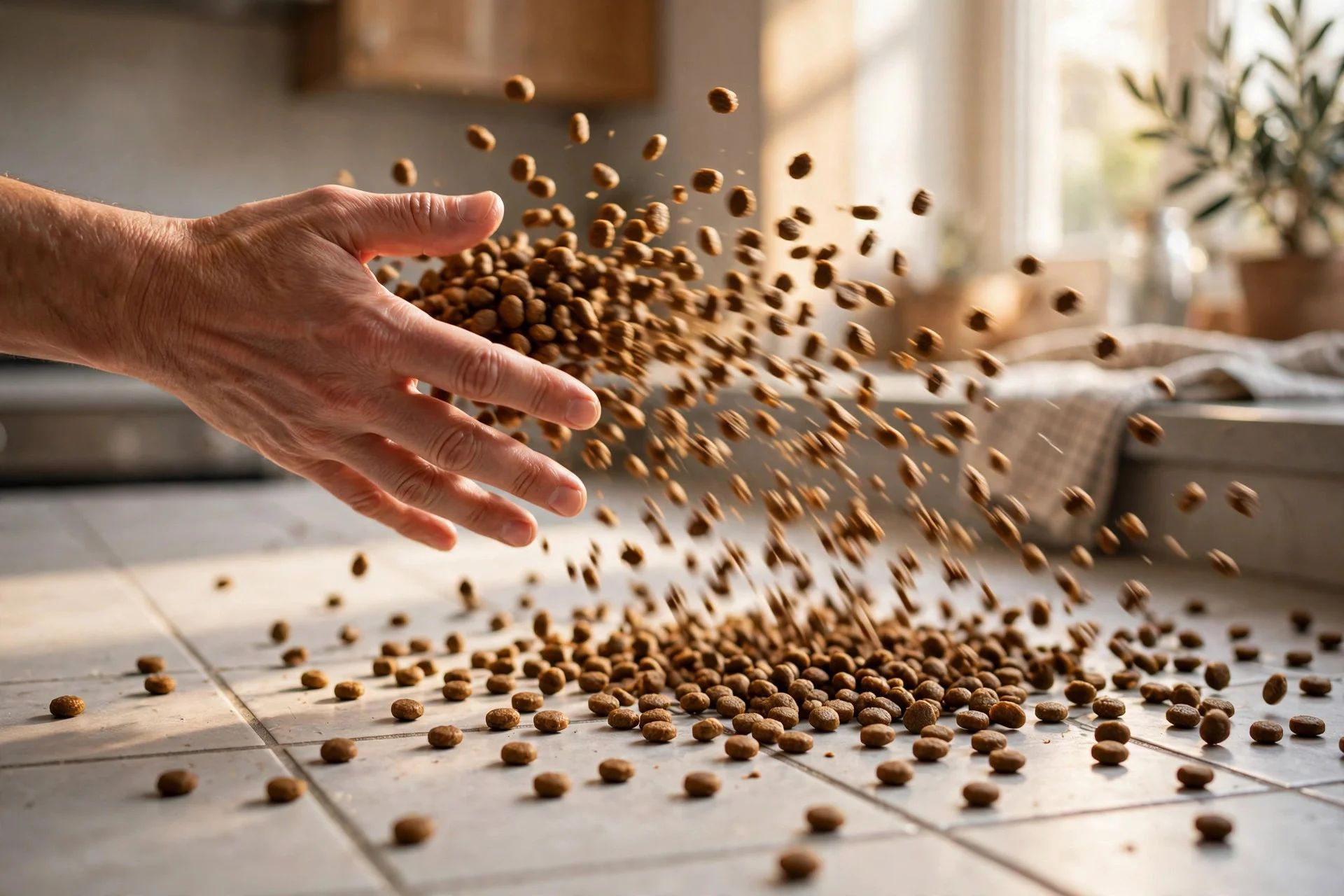
Your dog’s ancestors didn’t eat from a bowl. They spent hours searching, sniffing, and working for every bite. Then we domesticated them, put their food in a dish, and wondered why they inhale it in thirty seconds and spend the rest of the day bored. Scatter feeding dogs their meals instead of using a bowl gives some of that foraging back — you literally just throw their kibble on the ground instead of in a bowl.
That’s it. That’s the whole technique. But doing it well — safely, in the right places, for the right dogs — takes a little thought. Here are seven tips to start.
Scatter Feeding for Dogs: 7 Starter Tips
1. Start in the Kitchen, Not the Yard
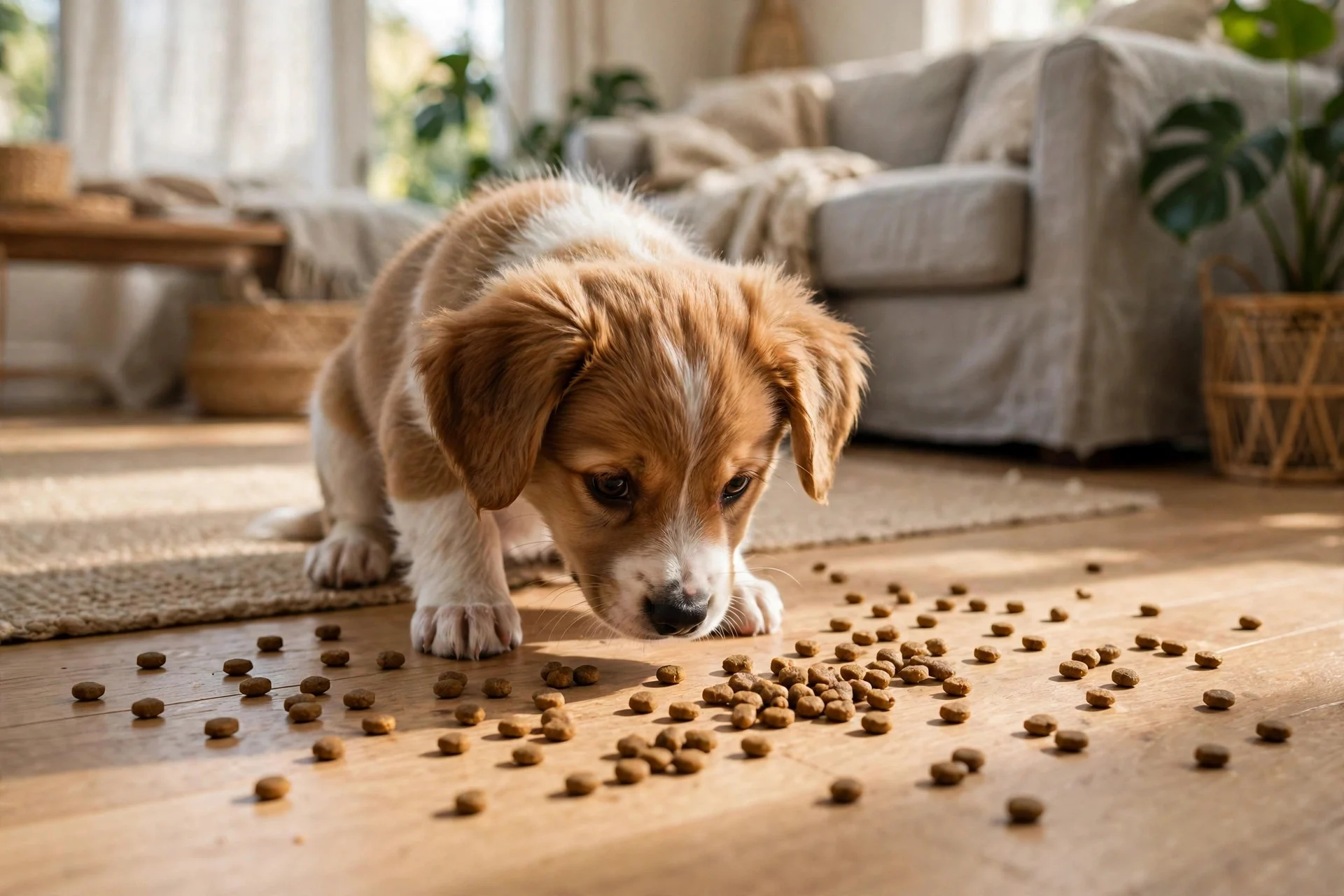
Your first scatter feed should happen on a clean, familiar indoor surface — kitchen tile or a hallway floor. Scatter a small handful of kibble over a six-foot area and let your dog find it. Indoors, there are no distractions, no weird smells, no half-buried hazards. The dog learns the concept fast: food is on the ground, nose goes down, good things happen. Most dogs get it within a minute. Once they’re confidently snuffling up every piece indoors, you can graduate to the yard. Starting outside is a common mistake — too many smells, too much novelty, and the dog spends more time investigating the environment than eating. Build the skill inside first.
2. Use the Right Surface
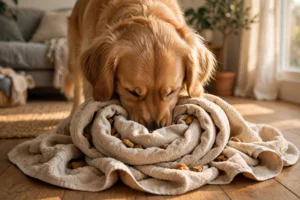
Not all ground is scatter-worthy. Clean tile, laminate, short dry grass, a patio, or a large towel laid on the floor are all great. Avoid: freshly fertilized or pesticide-treated lawns (chemicals plus nose-to-ground equals bad), gravel (kibble disappears into it and dogs ingest stones trying to fish it out), muddy areas (just… no), and anywhere other dogs frequent off-leash (parasite risk). I do most of my scatter feeding on the back patio — easy to sweep, no chemicals, and the slight texture variation between pavers makes it mildly challenging. A snuffle mat is the indoor premium version of the same idea.
3. Scatter Wide, Not in a Pile
The point is searching, not just eating off the floor. Toss the kibble with a wide, sweeping motion so pieces land a foot or more apart across a large area. A pile defeats the purpose — the dog just stands in one spot and eats, which is barely different from a bowl. Wide scattering forces movement, sniffing, and decision-making: which piece next? For beginners, keep pieces visible and within a smaller area. For experienced scatter feeders, go wide — across a whole room, around furniture legs, under (safe) obstacles. The wider and more varied the scatter, the more mental work involved.
4. Match the Food to the Method
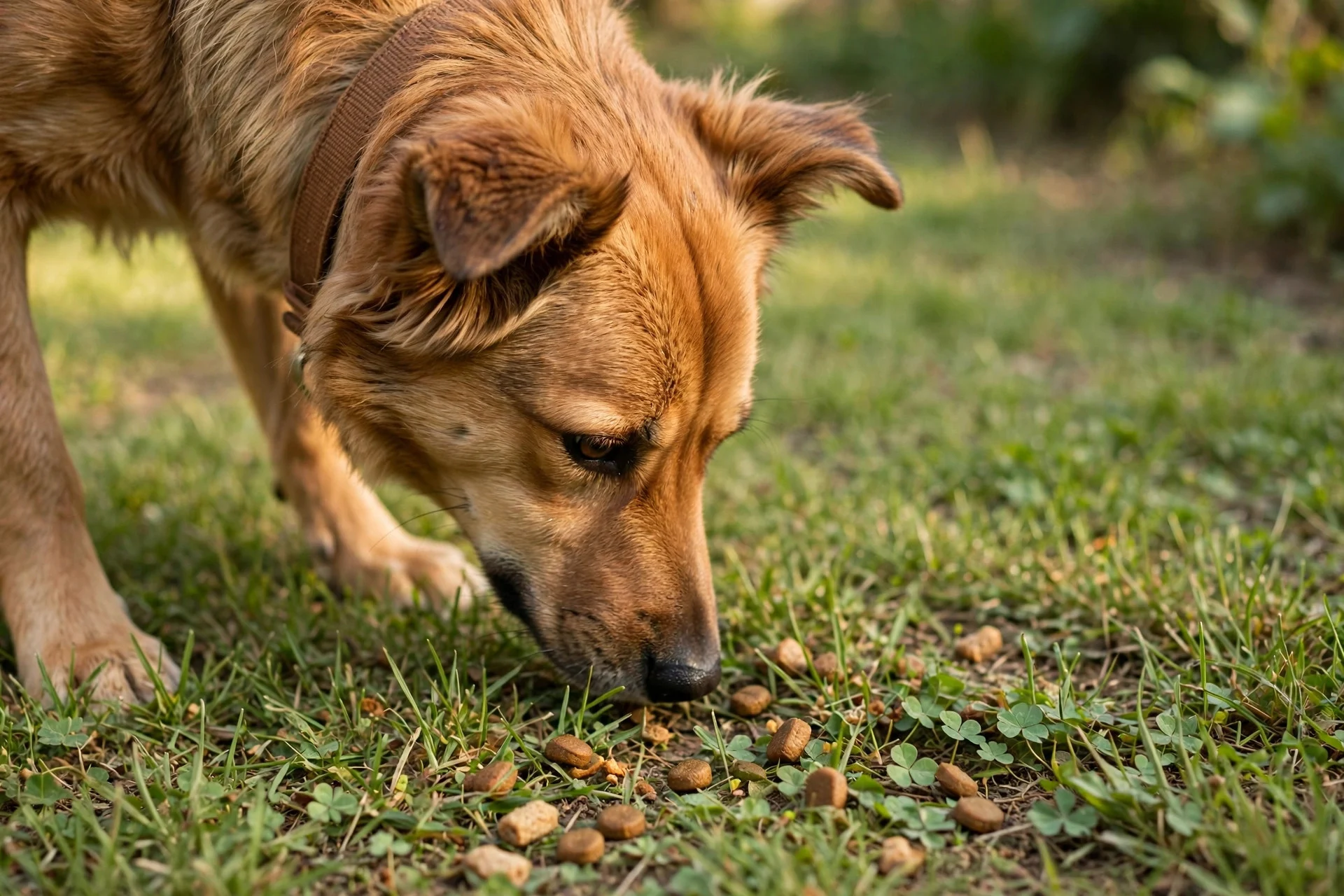
Kibble is the ideal scatter food — dry, distinct pieces that don’t stick to surfaces or melt. Wet food is a disaster scattered (imagine the cleanup). Raw food scattered outdoors raises hygiene concerns I’d rather not think about. If your dog eats wet or raw, scatter-feed a portion of freeze-dried treats or a small handful of kibble as a supplement instead of replacing the meal. And size matters: tiny kibble on a textured surface frustrates small dogs, while giant kibble pieces barely challenge a Labrador. If the kibble is very small, scatter on a smooth surface where pieces stay visible and retrievable.
5. Make It Harder Gradually
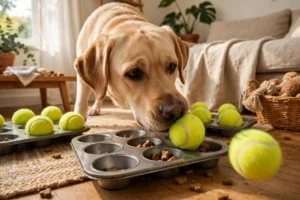
Once your dog masters open-floor scattering, add challenge layers. Scatter in longer grass so pieces are partially hidden. Toss some pieces behind chair legs or under a low table. Scatter across two rooms so the dog has to search room to room. Drop a few pieces on a snuffle mat mixed into the scatter area. Each variation adds difficulty without adding equipment. The progression keeps the dog’s brain engaged — and a dog who’s thinking is a dog who’s not chewing your baseboards. Watch for frustration, though: if the dog gives up and walks away, you’ve made it too hard. Dial it back. The sweet spot is “challenging but solvable,” and it shifts as the dog gets better.
6. Use It for More Than Meals
Scatter feeding isn’t just a breakfast replacement. Scatter a few treats in the yard before you leave for work — it gives an anxious dog a project instead of a panic. Scatter treats along a walking route to practice loose-leash focus. Scatter in a new environment to help a nervous dog settle — sniffing is calming, and a dog who’s sniffing isn’t fixating on scary things. It’s also brilliant for rainy days when walks get cut short: a full meal scattered across two rooms buys you real time.
7. Know When Not to Scatter
Scatter feeding isn’t for every dog or every situation. Skip it for: dogs with severe resource guarding (scattered high-value food across a wide area can trigger guarding over a whole zone — work with a trainer first), multi-dog households where dogs compete over food (scatter in separate areas or skip it), dogs recovering from surgery or on restricted movement (snuffling is low-impact, but wandering a yard isn’t rest), and very windy days outdoors (your kibble becomes the neighborhood’s kibble). Also skip it right before training sessions where you need food motivation — a dog who’s just foraged a full meal is not going to work for kibble rewards. Timing matters.
Tips That Actually Matter
Count the scattered food toward daily calories — it’s still food, even if it felt like a game. For dogs who eat too fast, scatter feeding is genuinely one of the best fixes: it physically prevents gulping and the frantic post-meal energy that comes with it. And rotate your scatter spots. Dogs memorize locations fast (mine learned “behind the planter” in two days), so change it up to keep the searching honest.
Mistakes to Avoid
Don’t scatter on treated lawns — this is the big safety one. Fertilizers, pesticides, and herbicides are all nose-level hazards. Don’t scatter and walk away for hours; food left out attracts pests and goes stale, and an unsupervised dog might eat something else they find out there. Don’t use it as the only enrichment — it’s wonderful, but variety matters. And don’t scatter the entire meal for a dog who’s never done it before and then leave for work. Start small, supervise the first few sessions, and build up.
FAQs
Does scatter feeding really slow down fast eaters?
Yes — dramatically. A dog who inhales a bowl in thirty seconds will take five to fifteen minutes to scatter-feed the same amount. It physically prevents gulping because the dog can only pick up one or two pieces at a time.
Can I scatter feed every meal?
You can, as long as the surface is safe and you’re supervising. Many people scatter-feed breakfast and bowl-feed dinner, or vice versa. There’s no rule — do what fits your routine.
Is scatter feeding okay for puppies?
Absolutely. It’s one of the best puppy activities — it teaches them to use their nose, builds confidence, and tires them out mentally. Start indoors with a small area and their regular kibble.
What about raw or wet food?
Stick to kibble or dry treats for scattering. Wet and raw foods make a mess and raise hygiene issues outdoors. If your dog eats wet food, scatter a small portion of dry treats separately as the enrichment piece.
The bowl was never the point. Dogs are foragers with noses that put ours to shame — scatter feeding just lets them be what they are. Try it tomorrow morning. The worst case is a slightly crumby floor and a very happy dog.