The walk starts fine. Then another dog appears down the block, and your sweet, gentle dog transforms — lunging, barking, spinning at the end of the leash like a tiny tornado. If this is your life, you’re dealing with leash reactivity, and I want you to hear something important first: your dog is not aggressive, not dominant, and not “bad.” Leash reactivity training works because reactivity is almost always frustration or fear, not malice — and both of those are fixable emotions.
Here’s what reactivity actually is: your dog sees a trigger, feels a big emotion about it, and explodes because the leash removes his option to create distance. Off leash, most reactive dogs would move away or approach calmly. On leash, they’re trapped — so they shout. Our job is to change the emotion, not suppress the shouting.
8 Training Exercises for Leash Reactivity
1. Find his threshold distance — and respect it
Every reactive dog has a threshold: the distance at which he notices a trigger but can still think. Inside that distance, his brain floods and no learning happens. Start far away and watch his body. All training happens at or beyond this distance — working inside threshold just makes things worse.
2. The “look at that” game
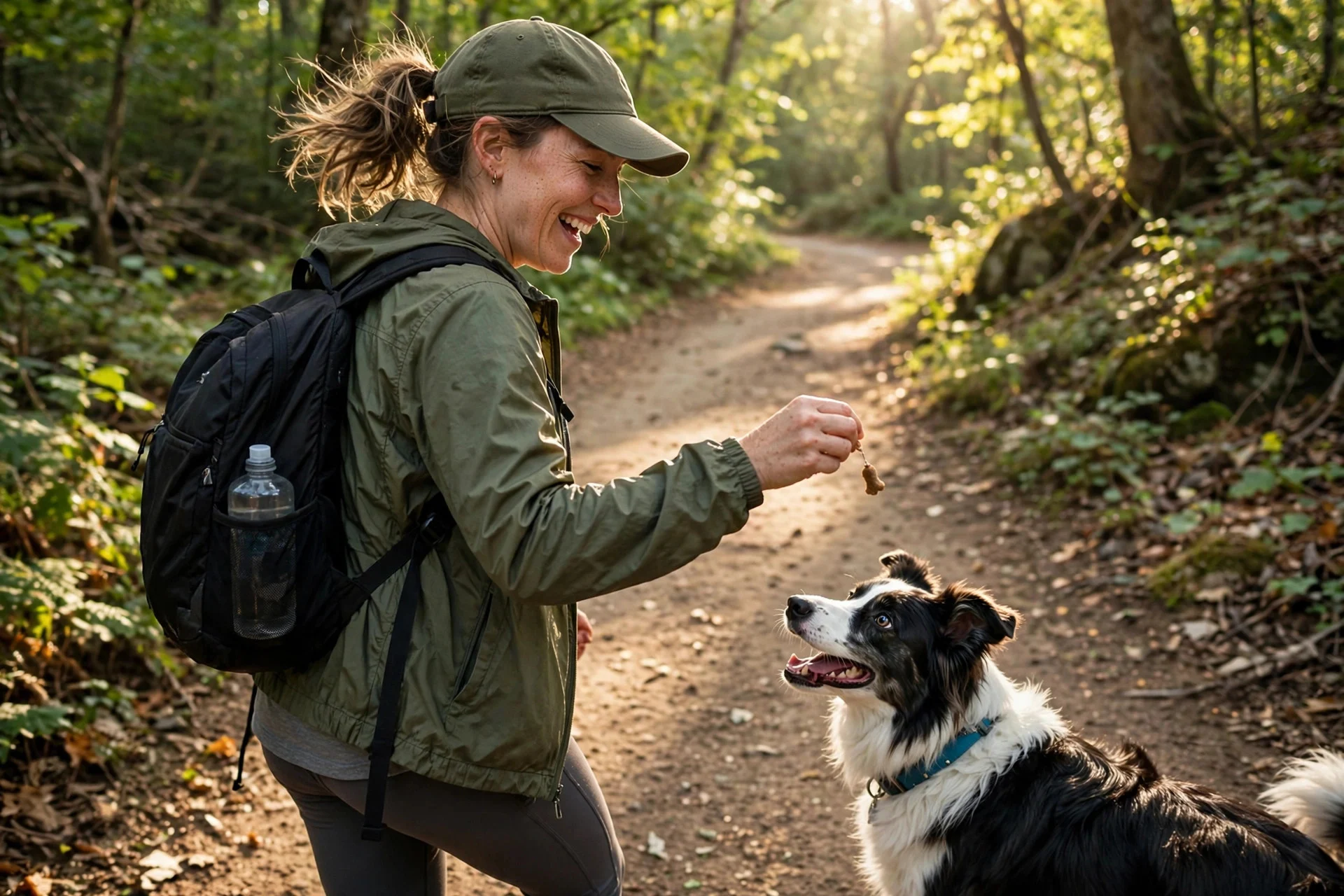
At threshold distance, let him notice the trigger, then the instant he looks at it, mark (“yes!”) and treat. Repeat. What you’re building is a new pattern: trigger appears → check in with human → get paid. Over weeks, his emotional response starts shifting from “threat!” to “treats are coming.”
3. U-turns: the graceful exit
Train a happy U-turn: say “this way!” cheerfully, turn 180 degrees, and jog a few steps while luring him with a treat. Practice it with no triggers present until it’s automatic. A clean exit beats a meltdown every time.
4. “Find it” scatter game
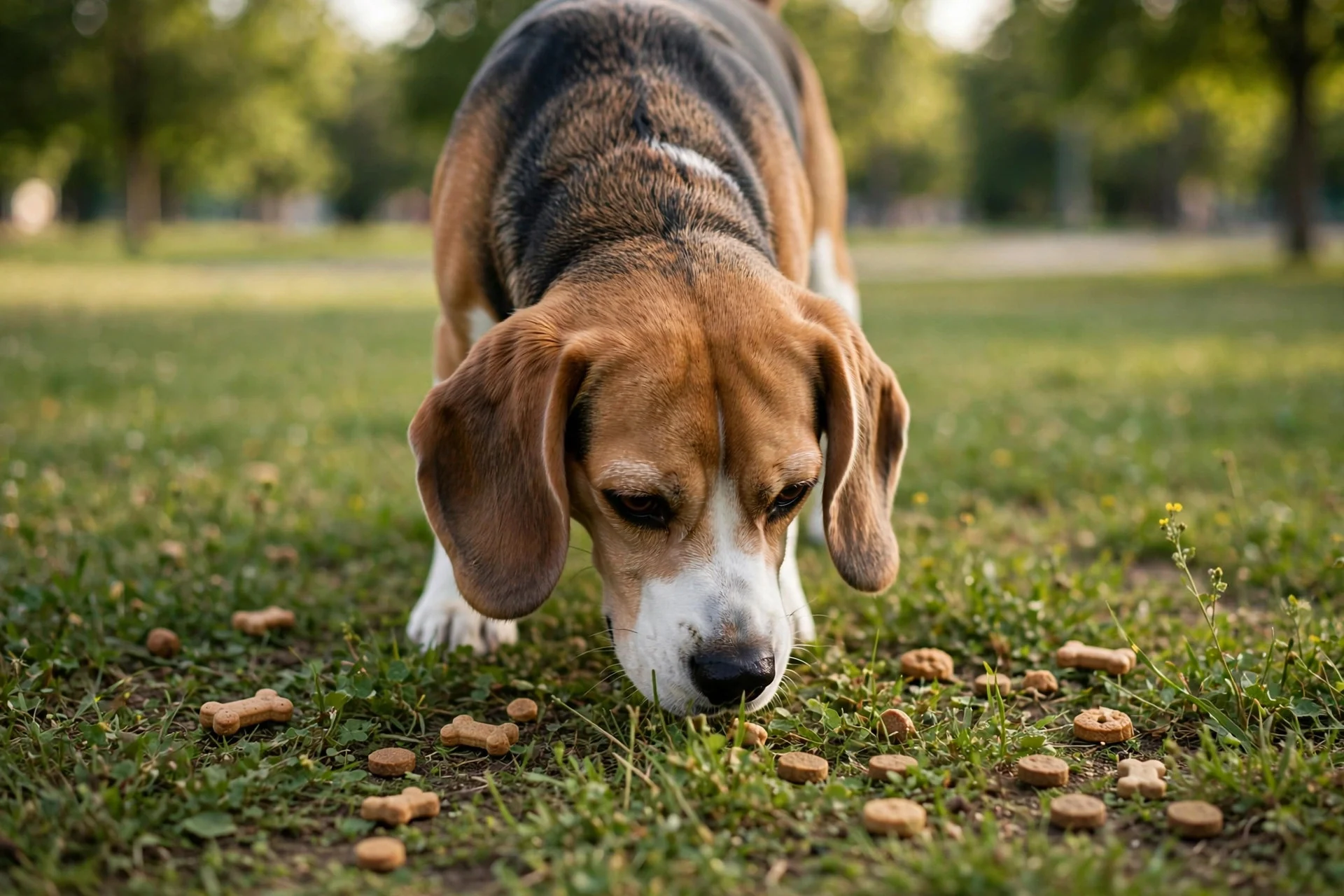
When a trigger appears at a manageable distance, toss treats into the grass and say “find it!” Sniffing is naturally calming — it lowers heart rate and shifts the brain out of reactive mode. While he’s snuffling, the trigger passes.
5. Mat work for stationary triggers
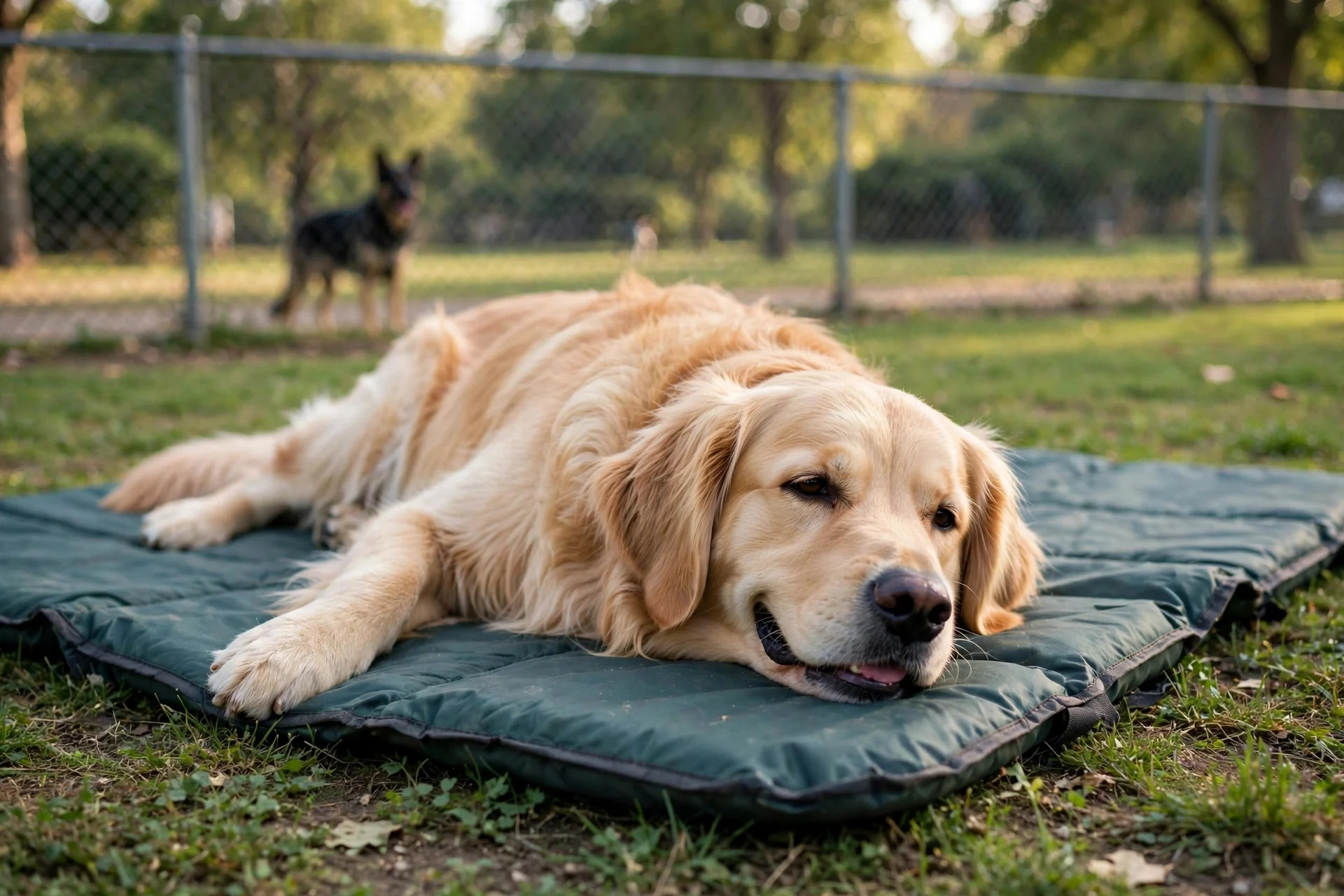
Some triggers don’t move past — the neighbor’s dog barking behind a fence, for example. For these, a portable mat is gold. Train a solid “go to mat and settle” at home first, then bring the mat to the park at threshold distance from the stationary trigger. He lies on his mat, gets a steady stream of rewards for calm behavior, and learns that exciting things happening over there predict good things right here. It’s classical conditioning doing the heavy lifting.
6. Parallel walking with a calm helper dog
This needs the right helper: a calm, neutral dog with an experienced handler. Start at a large distance, walking the same direction. Over multiple sessions, gradually decrease the distance as both dogs stay relaxed. Never rush this.
7. Pattern games for predictability
Reactive dogs are stressed dogs, and predictability reduces stress. Build little rituals: every time you see a trigger, you do the same three-step sequence — “look at that,” treat, U-turn. The pattern itself becomes soothing because he knows exactly what happens next. Trainers call these “pattern games,” and they’re especially powerful for dogs whose reactivity is fear-based. A dog who can predict the future is a calmer dog.
8. Decompression walks in low-trigger environments
A few times a week, take him somewhere with almost no triggers on a long line and just let him sniff. These decompression walks lower his overall stress baseline, which means his threshold distance shrinks and training goes better. Skip them and progress stalls.
Practical Tips That Make It Stick
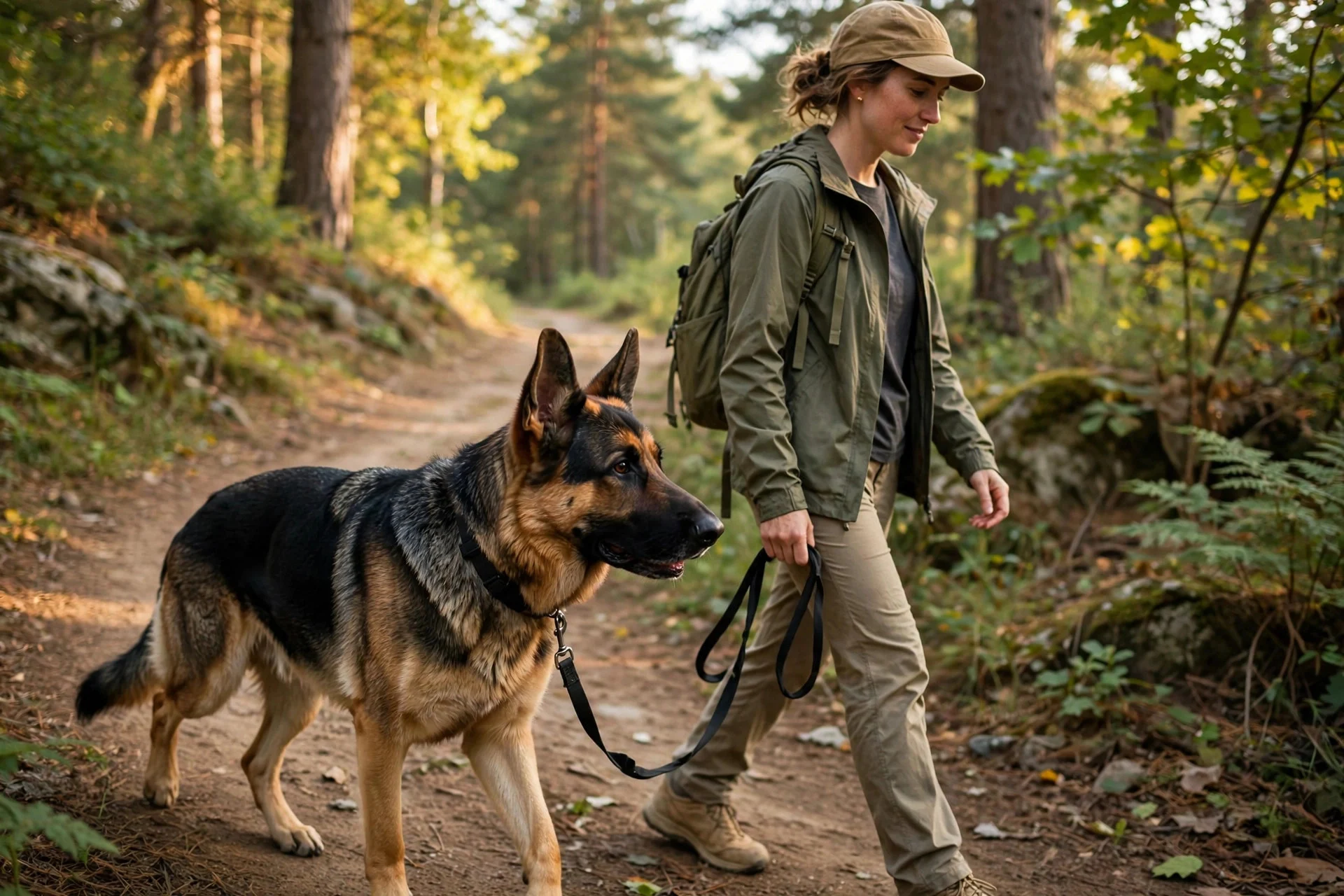
Upgrade your gear. A well-fitted front-clip harness gives you steering without pain — and pain is the enemy here, because anything that hurts during a reaction gets associated with the trigger. Skip choke chains, prong collars, and anything that “corrects.” They suppress the barking while increasing the underlying fear, which is the worst possible trade.
Walk at off-peak hours while you’re training. Fewer triggers means more successful reps, and successful reps are what build the new emotional response. The busy Saturday park is for later, when he’s ready.
Keep sessions short — fifteen to twenty minutes of focused work is plenty. Reactivity training is emotionally draining for the dog. End on a win, always.
Track your threshold distance in a notebook. When you started, maybe it was fifty yards. A month later, maybe it’s thirty. Progress with reactivity is slow and non-linear, and having the numbers keeps you motivated on the weeks it feels like nothing’s changing.
Mistakes That Make Reactivity Worse
Leash corrections — yanking, popping, “correcting” the lunge — are the biggest one. They don’t teach the dog to feel differently about the trigger; they teach him that triggers predict pain. The reactivity might look suppressed for a while, but the underlying emotion gets worse, and suppressed reactivity has a nasty habit of resurfacing as a bite “out of nowhere.” The science here is clear: aversive methods increase aggression.
Flooding him — dragging him toward triggers to “get him used to it.” Overwhelming a fearful dog doesn’t desensitize him; it sensitizes him further. Every over-threshold explosion is practice at exploding. Distance is your friend. Always.
Inconsistency between handlers. If one person does careful counter-conditioning and another yanks the leash and yells, the dog gets mixed signals and the fear wins. Everyone on the same program, or the program doesn’t work.
And skipping the management. Training without management is like bailing water without plugging the leak. Avoid trigger-stacked situations (the dog park, the busy sidewalk) while you’re working through the program. You can revisit them later.
FAQs
Is my reactive dog aggressive?
Almost certainly not in the way you fear. True aggression — intent to harm — is rare. Leash reactivity is overwhelmingly frustration (barrier frustration: “I want to go say hi and this leash won’t let me!”) or fear (“that thing scares me and I can’t get away”). Both are emotions, and emotions can be changed. The lunging looks scary, but the motivation matters more than the volume.
How long does reactivity training take?
Months, not weeks — and that’s normal. Expect to see small improvements (slightly shorter threshold distance, faster recovery after a reaction) within three to four weeks of consistent work. Meaningful, reliable change typically takes three to six months. Anyone promising faster results is selling something.
Should I let my reactive dog greet other dogs?
Not during the training program. On-leash greetings are tense, head-on, and over quickly — exactly the scenario that feeds reactivity. Keep walks moving and use your U-turns and pattern games. Social needs can be met through carefully managed play with known calm dogs, not random sidewalk encounters.
When should I get professional help?
If your dog has bitten or attempted to bite, if the reactivity extends to people (not just dogs), or if you’re not seeing any progress after a month of consistent work — get help. Look for a CPDT-KA trainer or veterinary behaviorist who uses humane methods. Ask directly: “Do you use prong collars, e-collars, or leash corrections for reactivity?” If yes, keep looking.
Leash reactivity feels embarrassing and exhausting, but it’s one of the most common behavior issues trainers see — and one of the most responsive to patient, humane work. Find the threshold, play the games, manage the environment, and ditch anything that hurts. Your dog isn’t giving you a hard time. He’s having a hard time. Help him through it, one calm walk at a time.