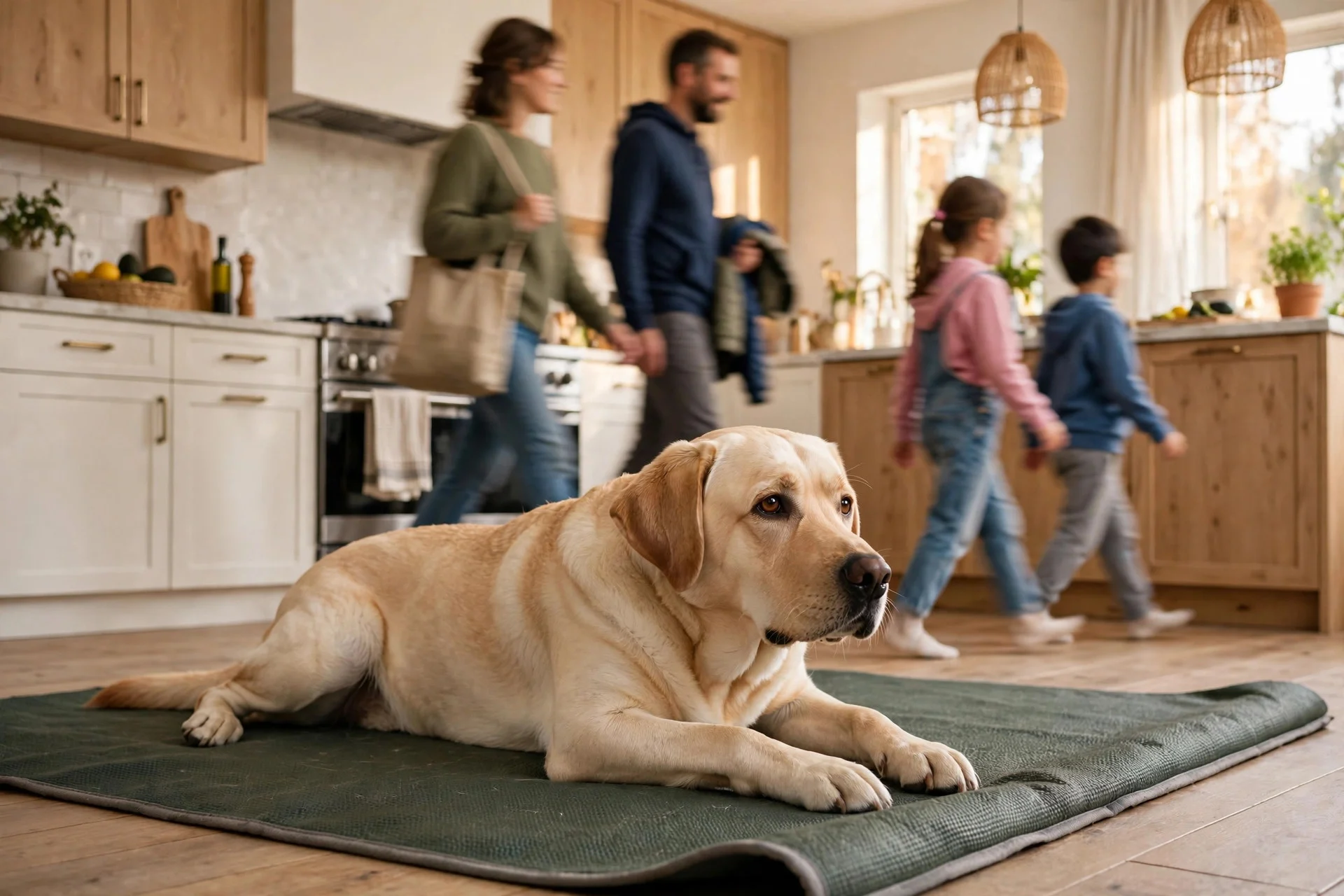
Want a dog who can actually settle while the doorbell rings, the kids eat dinner, and the Amazon driver does his thing? That is exactly the skill place command dogs master — going to a mat, lying down, and hanging out until you release them. It is one of those skills that sounds fancy but is really just station training with a cozy target.
I taught place to my first rescue back when I had no idea what I was doing. The goal was simple: I needed her to stop body-checking every guest who walked in. Teaching the place command for dogs turned her from a chaos gremlin into a dog who would park herself on a rug and watch the whole scene like she was reviewing a movie. Here is the exact 6-step process I would use again.
How to Teach the Place Command in 6 Steps
Step 1: Pick a Place Mat That Is Obviously Different
Your dog needs a target that screams “this is the spot.” A flat mat, an old towel, a bathmat — something with clear edges. Not their bed, not the couch. The whole point is that “place” is a station, a job location, not a nap spot. Something roughly 24 by 36 inches works for most dogs. Set it on the floor, let your dog sniff it, and just click and treat or say “yes!” the instant they look at it. You are not teaching a behavior yet. You are telling them this mat is a magic treat zone.
Step 2: Reward Paws on the Mat
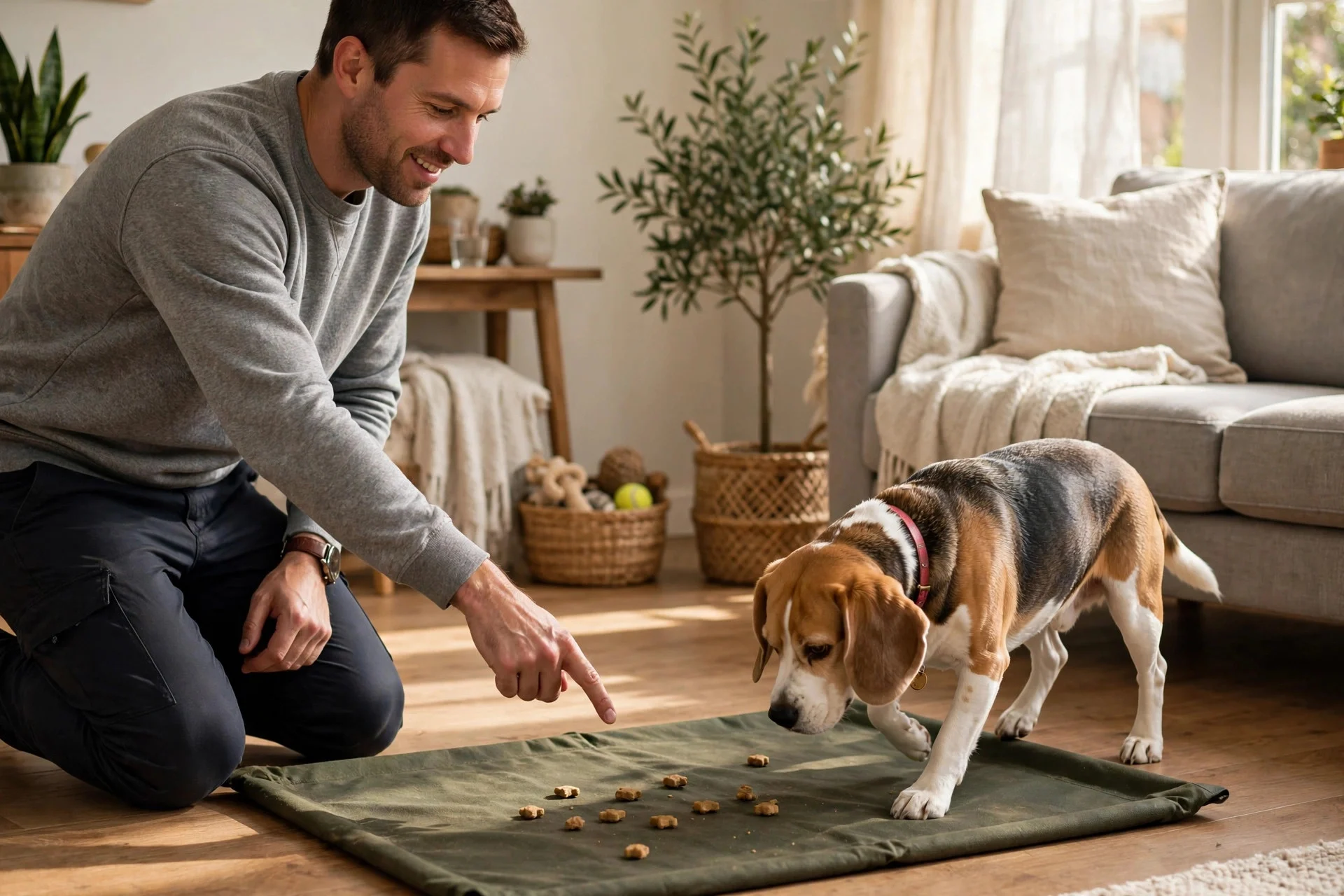
Toss a treat onto the mat so your dog steps on it to eat it. Then another. Then another. Before long, they will start stepping onto the mat on purpose because treats seem to fall from the sky there. Now wait. Dogs are gamblers at heart — they will try offering behaviors to see what pays. The moment all four paws land on the mat, mark and reward. Do this ten or fifteen times in short sessions. No cue word yet. You are just building value for the mat.
Step 3: Add the Down Once Paws Are Automatic
Once your dog is sprinting to the mat on sight, start waiting them out. They will run to the mat, stand there, and stare at you like, “Well? Where is my paycheck?” Lure them into a down with a treat, or wait for them to offer one — most dogs figure it out within a minute or two since lying down is comfortable. Mark and reward the down heavily. Repeat until they are running to the mat and flopping into a down as one fluid motion. This usually takes two or three short sessions.
Step 4: Add the Cue Word “Place”
Now say “place” right before your dog goes to the mat — say it once, calmly, as they are already heading there. Then reward the down. After a dozen reps, try saying it when they are just standing nearby. If they go, party. If they stare blankly, you added the word too early — go back to saying it while they are moving and try again tomorrow. One word. No “go to your place right now, please.” Dogs do not process sentences. “Place.” That is the whole command.
Step 5: Build Duration Slowly
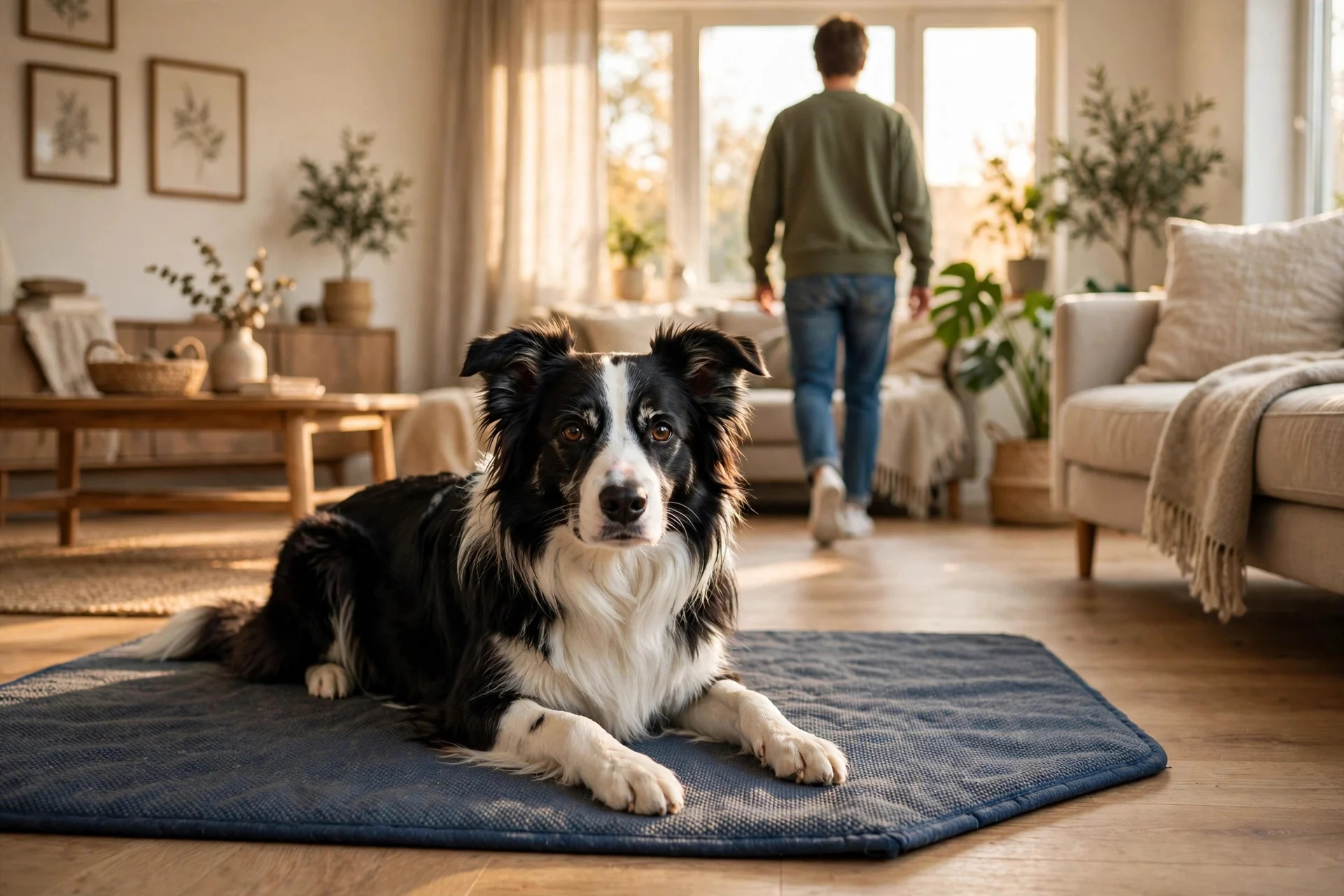
Start rewarding your dog for staying on the mat a little longer before releasing them. Treat every few seconds at first, then every ten, then every thirty. The release word matters here — use “free” or “okay” and mean it. Every single rep ends with a release so your dog learns place is a temporary job, not a prison sentence. Build to a couple of minutes over a week or two. Boring? Sure. That is the point. A dog who can do nothing on a mat for five minutes is a dog who can survive Thanksgiving.
Step 6: Add Distance and Real-Life Distractions
Now send your dog to place from across the room. Then from the hallway. Then while the TV is on. Then while someone walks past. Increase one thing at a time — distance, duration, or distraction, never all three. If your dog pops off the mat, you went too far too fast. Just quietly reset and try an easier version. Most dogs are solid within two to three weeks of short daily sessions. My rescue took 19 days. I know because I was counting, mostly out of disbelief.
Practical Tips That Make Place Stick
Practice where you will actually use it — by the front door, the kitchen, wherever chaos happens. Keep sessions under five minutes. End on a win, always. A tired dog learns place faster than a wired one, so get a walk in first. And bring the mat to friend’s houses once it is solid at home — portability is what makes place a superpower instead of a party trick. I have used the same mat at three apartments and a cabin. It still smells like victory and cheese.
Mistakes That Wreck the Place Command
Do not send your dog to place as punishment. If place becomes the “you were bad” mat, your dog will avoid it like a bill collector. Do not skip the release cue — a dog who never gets released starts releasing themselves. And do not rush distractions; every time your dog blows off place for something more exciting, the mat loses value. Slow wins the race. Also, never physically push your dog onto the mat. Lure, reward, shape — force has no place in place training. Pun intended.
FAQs About the Place Command
How long does it take to teach place?
For most dogs, two to four weeks of daily five-minute sessions. Fast learners get it in a week. Stubborn teenagers may take a month. It depends more on your consistency than their IQ.
Can I use a dog bed instead of a mat?
You can, but a dedicated flat mat travels better and keeps the concept clean. If you use their bed, “place” and “nap time” blur together, which is fine too — just know what you are building.
My dog keeps getting off the mat. What am I doing wrong?
Nothing is wrong — you just asked for too much. Drop the duration, drop the distance, drop the distraction. Reward small wins and rebuild. Also check that you are releasing them before they release themselves.
Should the dog stay in a down on the mat?
Most trainers prefer a down because it is calmer and easier to hold. A sit is fine for short durations, but down is the standard for real-life place. Pick one and be consistent.
The place command is the closest thing to a mute button on your dog. Six steps, a few weeks, and a mat. Start today and your future guests will wonder how you got so lucky.