My dog Rocky knew “sit” before he was four months old. Inside the house, he was a star student. I would say the word once, quietly, and his backside would hit the floor before I finished saying it. Friends were impressed. I was proud. I thought I had this whole training thing figured out.
Then we went to the park.
I said “sit” and Rocky looked at me like we had never met. I said it again, louder. Nothing. A jogger passed by and he lunged toward her, tail spinning like a propeller, and every single thing I had taught him over three months evaporated in about four seconds. I stood there holding a bag of treats he did not even glance at, feeling embarrassed and honestly a little betrayed.
If you are reading this, I am guessing something similar happened to you. Your dog is brilliant at home and completely deaf at the park. You are not alone, your dog is not stubborn, and no, he is not doing it to spite you. It took me almost a year of trial and error to understand what was actually going on, and once I did, the fix was more straightforward than I expected. Slow, but straightforward.
The Day I Realized the Problem Was Me
For the first few weeks I blamed Rocky. I told my wife he was being difficult. I told the vet he was “testing boundaries,” a phrase I had picked up from some forum. The vet, to her credit, did not laugh at me. She asked one question that changed everything:
“Where did you teach him to sit?”
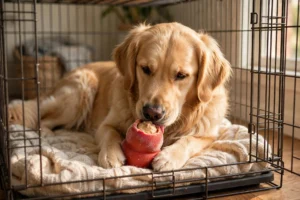
In the kitchen. Always in the kitchen. Same spot, same time of evening, same bag of chicken treats sitting on the counter.
“So he knows how to sit in your kitchen,” she said. “He has no idea what sit means at the park.”
That sounded ridiculous to me at first. A command is a command. But dogs do not think in words the way we do. They think in pictures and situations. To Rocky, “sit” did not mean lower your body to the ground. It meant when I am standing on the kitchen tiles and the human near the counter makes that sound, I put my bum down and chicken appears.
Change the floor, change the smells, change the lighting, and as far as Rocky was concerned, the deal was off. Trainers call this a generalization problem. Dogs are terrible at generalizing. It is not a flaw in your dog. It is just how their brains work, and once you accept it, everything about outdoor training starts making sense.
Why Outside Is a Completely Different Planet for Your Dog
Before I get to what worked, it helps to understand what your dog is actually dealing with out there, because I underestimated this badly.
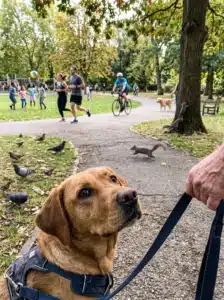
Think about what a park is from a dog’s point of view. Every blade of grass carries scent messages from every dog that walked past in the last few days. There are squirrels. There are pigeons. There are children running, cyclists whizzing past, food wrappers under benches, other dogs barking three streets away that you cannot even hear. A dog’s nose is thousands of times more sensitive than ours, so what feels like a quiet morning walk to you is, for your dog, standing in the middle of a carnival with fireworks going off.
Now imagine someone asked you to solve a maths problem in the middle of that carnival. You know maths. You are good at maths. But right now? You physically cannot focus on it.
That is your dog at the park. He is not ignoring you. He literally cannot process your voice over everything else competing for his attention. Understanding this stopped me from getting frustrated, and getting my frustration under control turned out to matter more than I realized, because dogs read our tension instantly. The more annoyed I got, the worse Rocky performed. It was a loop, and I was the one feeding it.
The Three Mistakes I Was Making
Looking back, I was sabotaging myself in three specific ways. Check if any of these sound familiar.
I repeated commands. “Sit. Sit! Rocky, SIT.” What I taught him, without meaning to, was that the first two “sits” are optional background noise. Why respond immediately when the human always says it five more times? Dogs learn patterns frighteningly fast, including the patterns we never intended to teach.
My treats were boring. The dry biscuits that worked fine in my quiet kitchen were worthless at the park. I was essentially offering Rocky one rupee to ignore a festival. Competing with squirrels requires better currency, and I will get to exactly what I switched to in a moment.
I skipped about ten difficulty levels. I went straight from the kitchen to the busiest park in our area on a Sunday evening. That is like teaching a child to swim in a bathtub and then throwing them into the sea. There is supposed to be a ladder of difficulty in between, and I had no idea it existed.
What Finally Worked: The Slow Ladder Method
I did not invent any of this. I pieced it together from a local trainer I eventually hired for two sessions, a lot of reading, and months of adjusting things when they did not work for Rocky specifically. Here is the exact progression we followed.
Step 1: Retrain in every room of the house
This felt pointless and I almost skipped it. Do not skip it. I re-taught “sit” in the living room, the bedroom, the hallway, and near the front door, treating each location like Rocky had never heard the word before. If your dog is an adult rescue rather than a puppy you raised, this stage looks a little different, and I have covered that separately in teaching an older rescue dog basic commands without stress. Some rooms took two minutes. The front door took two days, because the front door already meant walk time in his head and he was too wound up to think.
That front door struggle was actually my first real lesson. Excitement level matters as much as location. A dog at excitement level eight out of ten cannot learn. You have to catch them at a three or four.
Step 2: The boring doorstep phase
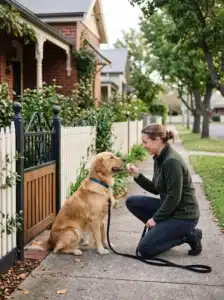
Next we practiced on the doorstep with the door open. Then one step outside. Then the gate. We spent an entire week just at the gate, and I am not exaggerating. My neighbor definitely thought I had lost my mind, standing at my own gate saying “sit” to a dog forty times a day.
But something clicked during that week. Rocky started offering the sit before I even asked, because he had figured out that the gate was now a place where sitting produces chicken. That was the moment I understood the method was working. He was starting to generalize.
Step 3: Upgrade the pay
This was the single biggest practical change. I retired the dry biscuits and started carrying tiny pieces of boiled chicken and a little cheese in a small container. Real food, cut into pieces smaller than my fingernail, so I could give twenty rewards in a session without upsetting his stomach.
The rule my trainer gave me was simple: the harder the environment, the better the pay. Kitchen work earns biscuits. Street work earns chicken. Park work, in the early days, earned chicken AND cheese AND a happy voice AND sometimes a quick game of tug. It sounds like bribery. It is not. It is a salary, and once the behavior became automatic months later, I was able to fade the food down to occasional rewards without losing the response.
Step 4: The empty park at 6 a.m.
Our first real park sessions happened at sunrise, when the park was almost empty. No dogs, no joggers, no children. Just grass smells, which were distracting enough on their own, believe me.
We stayed for ten minutes. That is all. Short sessions, always ending on a success, even if the only success was one decent sit. I learned to quit while we were ahead instead of pushing until Rocky failed, which is what I used to do. Ending on a failure teaches the dog that training sessions are frustrating. Ending on a win makes them want to come back.
Step 5: Adding distractions one at a time
Over the next two months, we gradually moved our sessions later in the morning. First a park with one distant jogger. Then a park with a dog on the far side. Then closer. Then the weekend crowd, but standing fifty meters away from the action.
Distance became my volume knob. Whenever Rocky could not respond, I did not repeat the command or get annoyed. I just moved us further from whatever was distracting him, tried again, and nine times out of ten he could do it from the greater distance. Then next session we would try a little closer. Some weeks we moved forward. Some weeks a cricket match in the park sent us back three steps. That is normal, and expecting setbacks in advance saved me a lot of frustration.
The Timeline, Honestly
I want to be upfront about how long this took, because most articles make it sound like a weekend project.
From the doorstep phase to Rocky reliably sitting in a moderately busy park took us about four months. Reliable recall around other dogs took closer to seven months, and recall is a whole separate battle I might write about another time. Your timeline will depend on your dog’s age, breed, and how excitable he is. Rocky is an energetic mixed breed who finds everything fascinating, so if your dog is calmer, you may move faster than we did.
The point is that slow progress is still progress. One percent better each week beats a burst of effort followed by giving up.
A Few Things That Made a Surprising Difference
Saying the command once, then waiting. I trained myself to say “sit” a single time and then shut up for a full five seconds. It felt uncomfortable. But given actual silence to think, Rocky often worked it out on his own, and a sit he figures out himself sticks far better than one nagged out of him.
Rewarding eye contact for free. Any time Rocky looked at me at the park, without being asked, he got a treat. No command, no pressure. Within weeks he was checking in with me constantly, and a dog who is already looking at you is a dog who can hear you. This one habit probably did more for us than anything else on this list.
Feeding breakfast at the park. For a few weeks I skipped his morning bowl and he earned his entire breakfast through training at the park instead. A slightly hungry dog is a motivated dog, and it meant I was not adding extra calories on top of his meals.
Keeping the leash on longer than my ego wanted. I used a ten meter long line for months after I was “sure” he was ready for off leash. The one time I tested him too early, he bolted after a cat and set us back weeks in confidence, mine more than his.
When to Consider Getting Help
I will be honest, the two sessions I did with a local trainer were worth every rupee, mainly because she spotted my mistakes in about ninety seconds. Sometimes you need outside eyes.
You should also loop in your vet if your dog seems unable to focus anywhere, not just outside, or if the “ignoring” comes with pacing, trembling, or constant scanning of the environment. What looks like disobedience is sometimes anxiety, and anxious dogs need a different approach than the one I have described here. A quick health check also rules out hearing problems, which are more common in older dogs than people think. If hearing loss does turn out to be part of the picture, it is far from the end of training, I have written a full guide to hand signals every deaf or aging dog can learn.
The Short Version
If you take nothing else from Rocky’s story, take this: your dog is not ignoring you outside. He never learned the command outside in the first place, because dogs do not transfer skills between locations the way we assume they do.
So start over, closer to home than feels necessary. Pay better than feels necessary. Move slower than feels necessary. Say the command once and wait. Reward every voluntary glance in your direction. And when your dog fails, add distance instead of volume.
Rocky is three now. Last month a food cart tipped over near us at the park, chapatis everywhere, total chaos, and he sat on a single quiet cue while three other dogs lost their minds. The owner of the cart actually clapped. Fourteen months earlier that dog would have dragged me into the wreckage.
Same dog. Same command. I just finally learned how to teach it where it mattered.
If you are in the middle of the frustrating phase right now, stick with it. The 6 a.m. empty park sessions feel silly at the time, but they are quietly building something. One morning your dog will sit in the grass with a squirrel in plain view, look up at you waiting for his chicken, and you will remember exactly why you did not give up.