
A bored dog is a destructive dog. Ask anyone whose couch cushions have been “redesigned” by a restless retriever. A DIY snuffle mat dogs actually get excited about is one of the cheapest fixes I know — it turns mealtime into a 15-minute sniffing expedition, and it costs less than a bag of decent treats.
Snuffle mats tap into the one thing dogs were literally built to do: smell. Ten minutes of nose work tires a dog out more than a half-hour walk. And the best part? You don’t need a sewing machine, special skills, or more than about an hour. Here’s exactly how to make one, no sewing required.
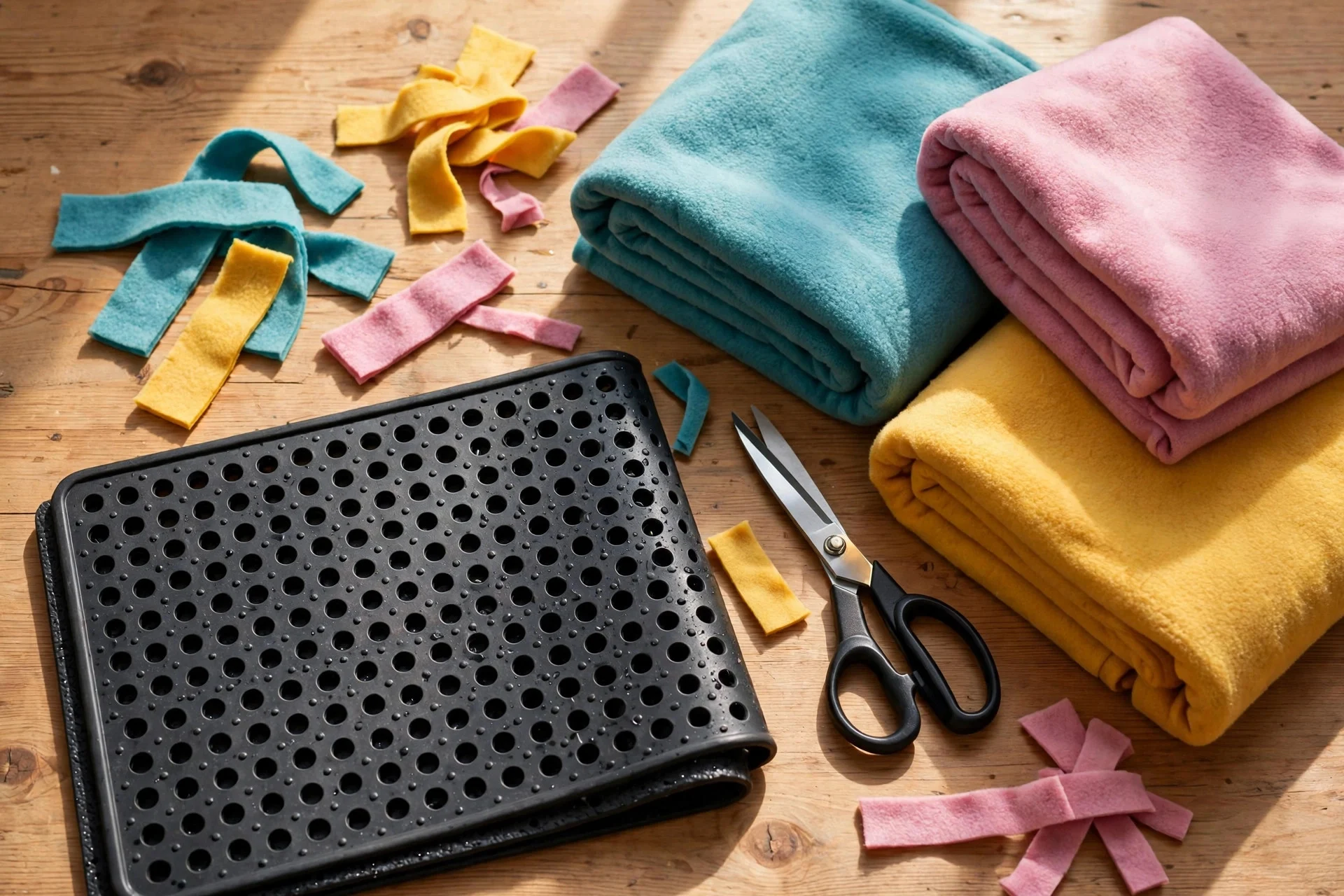
What You’ll Need
Before we start, grab your supplies. You’ll need a rubber sink mat or rubber doormat with drainage holes (the kind with a grid of holes, roughly 12 x 15 inches), one or two fleece blankets or several old fleece throws, and a pair of sharp scissors. That’s it. Fleece is the key fabric here — it doesn’t fray into strings the way cotton does, and strings are a swallowing hazard.
Cost check: a basic rubber sink mat runs about $8, and fleece blankets from a discount store are $4-5 each. Total damage: under $15. Store-bought snuffle mats go for $30-40 and honestly aren’t any better.
The 7 Steps
1. Wash and Prep Your Fleece
Run your fleece through the wash first — new fleece is often treated with sizing chemicals, and your dog will have their nose buried in this thing. Skip the scented detergent. Once dry, lay the blanket flat. Don’t iron it; you’re about to cut it into hundreds of strips anyway.
2. Cut the Fleece Into Strips
Cut strips roughly 1 inch wide and 6-7 inches long. They don’t need to be perfect — uneven is fine, even good, because variation makes the sniffing more interesting. A standard throw blanket gives you around 200 strips, which is plenty. Put on a podcast for this part. It takes about 30 minutes and your hand will cramp at least once.
3. Check Your Mat’s Holes
Flip your rubber mat over and look at the hole grid. Each strip gets threaded through a hole and tied off, so you want holes big enough to push fleece through but small enough that the knot holds. Standard sink-mat holes are perfect. If your mat has a smooth solid back with no holes, stop — you have the wrong mat. You need the holey kind.
4. Tie the First Row
Push one strip up through a hole from underneath, then tie a single overhand knot on top. Pull it snug but not strangling-tight — you want the strip to stand upright like grass, not lie flat. Work across one full row first to get your rhythm. After twenty or so, you’ll be doing it on autopilot.
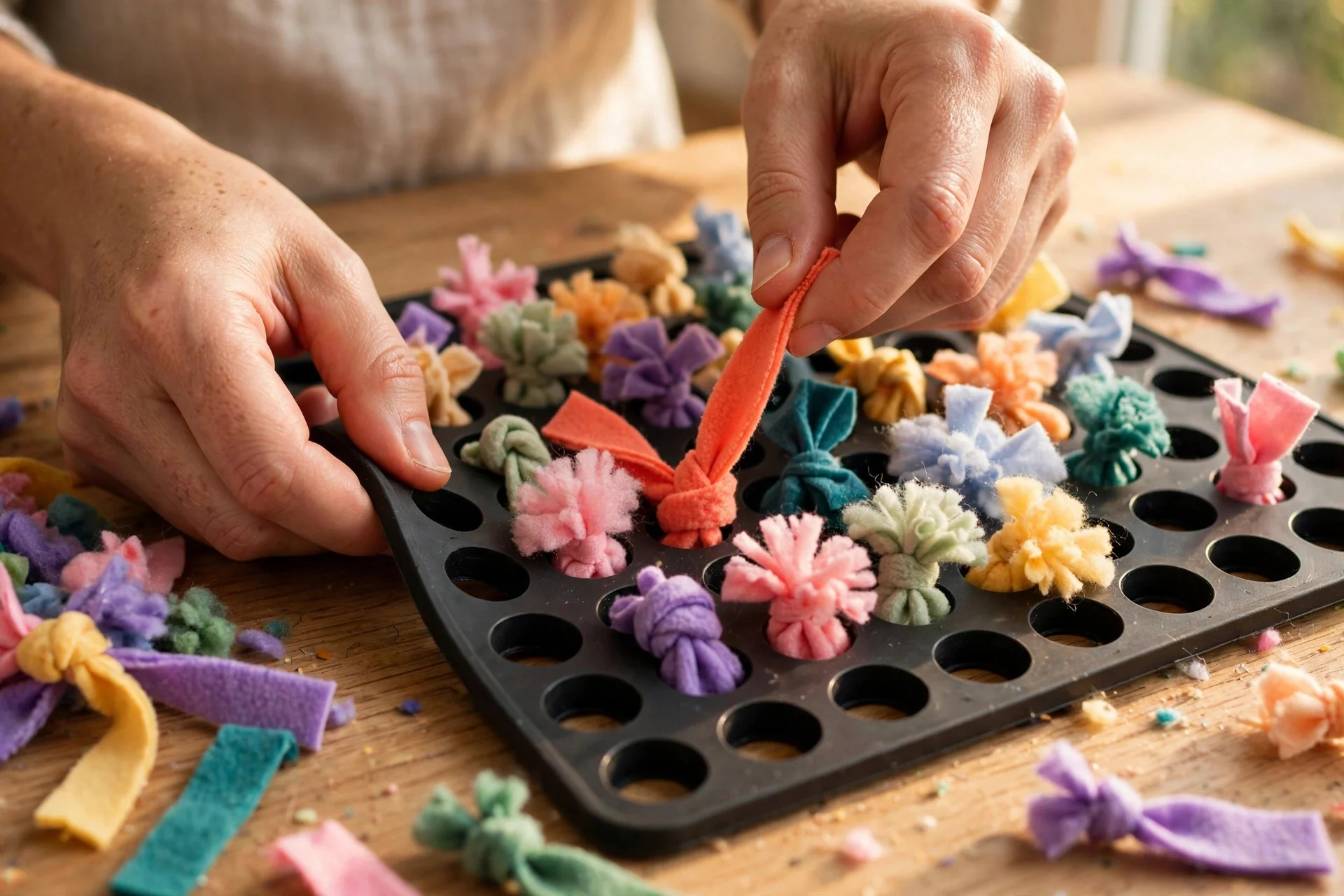
5. Fill the Whole Mat
Keep going, hole by hole, row by row. Alternate colors if you used more than one blanket — it looks nicer and, I swear, dogs don’t care at all. The denser the better: a packed mat hides treats more effectively and lasts longer before the dog figures out every hiding spot. This is the longest step, maybe 20-30 minutes.
6. Trim and Fluff
Once every hole is filled, give the mat a shake and fluff the strips up with your fingers. Trim any absurdly long strips down to match the rest. Flip it over and check the underside — no loose strips should be hanging free underneath, since those are the ones a dog can pull off and swallow. Re-tie anything sketchy.
7. Load It With Treats and Introduce It
Scatter a handful of small treats or kibble deep into the fleece, pushing some down near the base. For the very first session, make it easy — treats sitting right on top so your dog gets the idea. Let them sniff for 10-15 minutes, then pick the mat up. You want the mat to stay special, not become background furniture.
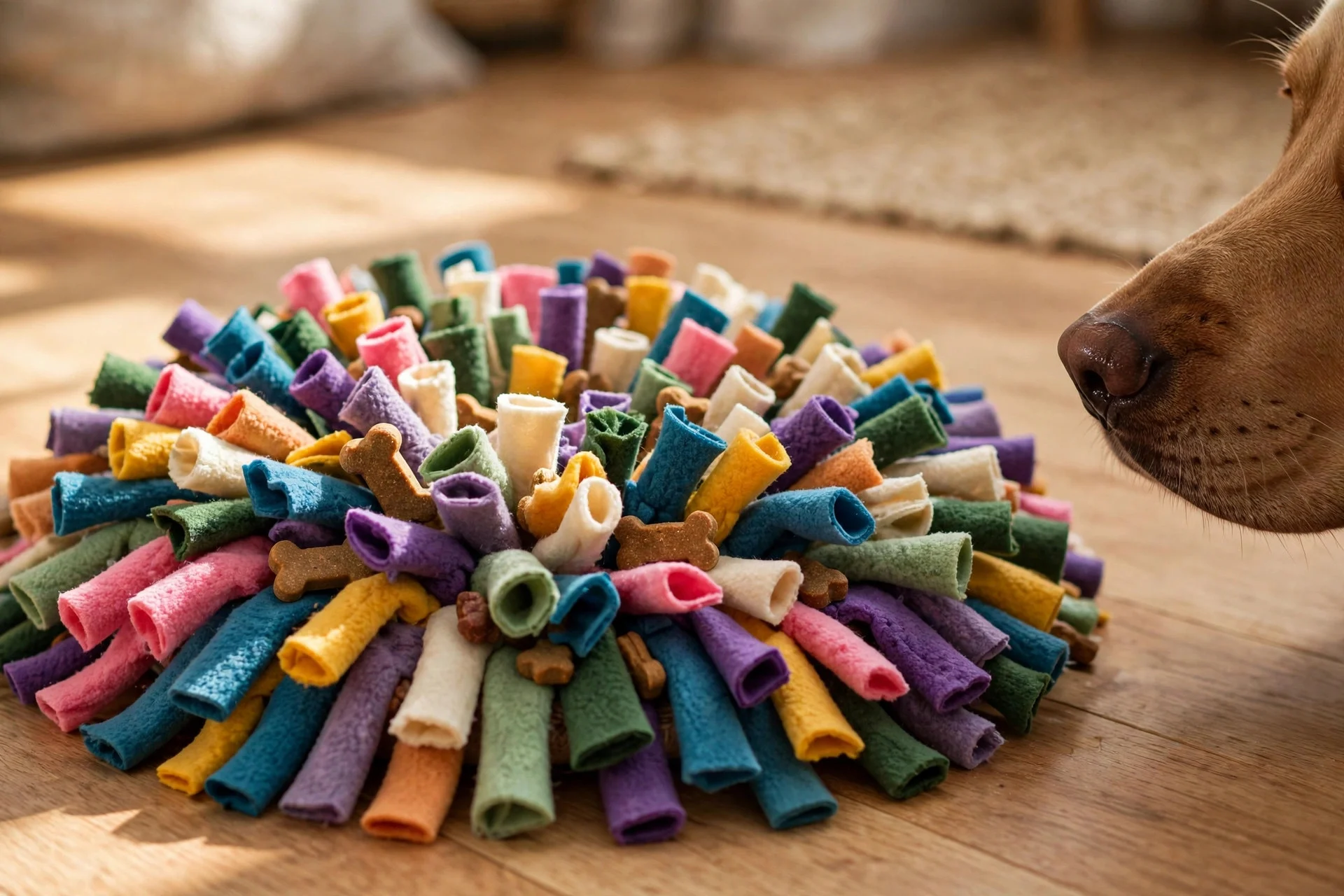
Tips to Get the Most Out of Your Snuffle Mat
Use it for meals, not just treats. Pour half your dog’s breakfast kibble into the mat instead of a bowl. It slows down gulpers beautifully — my friend’s Lab went from inhaling dinner in 40 seconds to a civilized 12 minutes. For multi-dog households, give each dog their own mat or supervise closely. Resource guarding over a snuffle mat is a real thing.
Rotate the difficulty. Some days scatter treats loosely on top (easy day). Other days bury them at the base and fold strips over them (hard day). In summer, dampen the fleece lightly and freeze the whole mat for 30 minutes before loading it — a cool sniffing session on a hot afternoon.
Mistakes to Avoid
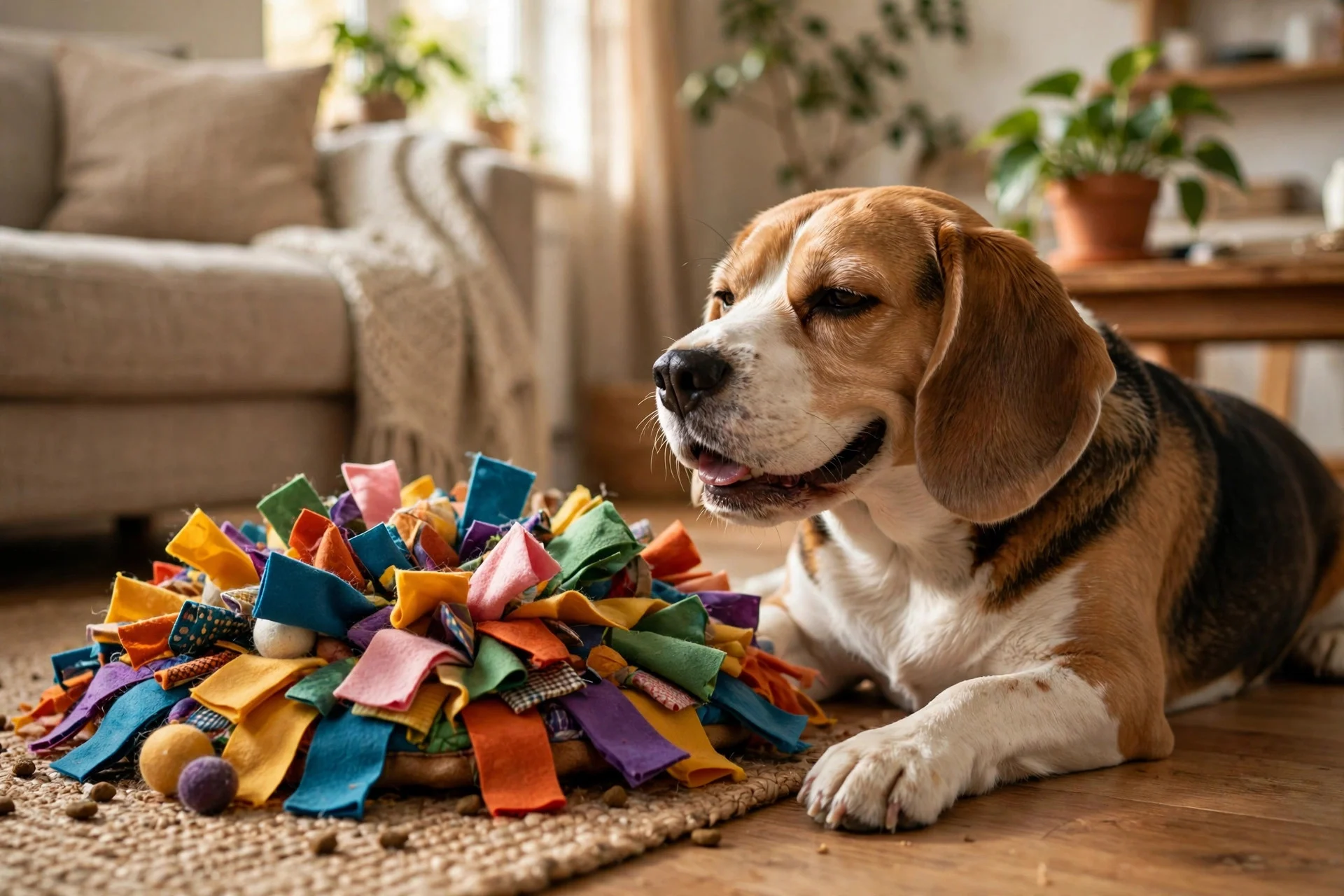
Don’t leave the mat down unsupervised, especially at first. Some dogs try to chew the fleece strips rather than sniff between them. If yours is a shredder, the snuffle mat becomes a supervised-only activity — still useful, just not a leave-and-go-to-work solution. And wash it weekly. Old treat crumbs and drool turn a snuffle mat into a science experiment fast. Toss it in the washing machine on gentle and air dry.
Also, don’t overload it on day one. A mat buried under a mountain of treats teaches the dog that snuffling = jackpot every time, and then a normally-loaded mat feels like a letdown. Start modest. Build the habit first, then get stingy — the sniffing itself becomes the reward.
FAQs
Can I use old t-shirts instead of fleece?
You can, but fleece is better. Cotton jersey frays into long strings when chewed, and strings can cause intestinal blockages if swallowed. Fleece tears into chunks instead. If t-shirts are all you have, cut wider strips and supervise closely, replacing frayed strips often.
How long do the fleece strips need to be?
Around 6-7 inches is the sweet spot. Shorter than 4 inches and treats won’t hide well; longer than 8 and the strips flop over and mat down. If your dog is tiny, scale down to 4-5 inch strips on a smaller mat.
Is a snuffle mat good for puppies?
Excellent for puppies, with one rule: always supervise. Puppies explore with their mouths, and a puppy left alone with a snuffle mat may decide the fleece itself is the toy. Short 5-minute sessions are plenty for a young pup.
How often should I wash it?
Once a week if you use it daily. Machine wash gentle, air dry — the dryer heat can warp the rubber mat. If it starts smelling funky between washes, that’s your sign you waited too long.
A snuffle mat won’t replace walks or training, but it’s the best $15 you’ll spend on beating boredom. Make one this weekend — your dog’s nose will thank you, and your couch cushions will survive another year.

























