
I did not notice my dog was going deaf. That is the part that still bothers me.
Max was thirteen, a scruffy terrier mix who had spent his whole life appearing in the kitchen the moment a cheese wrapper crinkled. So when he started sleeping through the doorbell, I told myself he was just tired. When he stopped coming when called in the garden, I joked that he had become a grumpy old man. It was our vet who finally clapped her hands behind his head during a routine checkup, watched him not react at all, and said gently, “You know he cannot hear you anymore, right?”
I drove home feeling like I had lost something. How do you talk to a dog who cannot hear you? How do you call him in from the garden, tell him dinner is ready, warn him you are about to touch him so he does not startle?
The answer, it turned out, was already wired into him. Dogs are not really listening to our words in the first place. They are watching us. Studies on canine communication keep confirming what trainers have said for decades, that dogs read body language far more fluently than they process sound. Max had been half watching my hands his entire life. All I had to do was make the hands official.
Within six weeks, my deaf senior dog knew more visual commands than he had ever known spoken ones. This is the complete system we used, signal by signal, and it works just as well if your dog still hears fine, because a dog who knows hand signals today will transition effortlessly if his hearing fades tomorrow.
Before the First Signal: Three Ground Rules

Rule one: get his eyes before anything else. A hand signal a dog does not see never happened. With a hearing dog you can say his name first. With a deaf dog you need other attention getters, and I will cover those in a moment, because attention itself becomes the most important “command” you will ever teach.
Rule two: keep every signal big, slow, and different from the others. In the beginning I made my signals small and quick, the way you would gesture to a person. Max constantly confused them. Old eyes are often cloudy eyes, and many senior dogs are losing some vision along with the hearing. Exaggerate everything. You can shrink the signals later once they are solid.
Rule three: your face is part of the signal. Deaf dogs become experts at reading expressions. Signal with a soft, pleasant face. A tense jaw or a frustrated frown changes the meaning of your hands completely, and a worried dog stops offering behaviors. Half of my early failures with Max traced back to my own irritated face, not his understanding.
One more thing before the list. Since a deaf dog cannot hear “good boy,” you need a visual marker to replace it, a signal that means yes, that exact thing, payment is coming. Mine is a quick thumbs up, flashed the instant Max does something right, always followed by a treat. Teach this first. Just flash the thumbs up and hand over a treat, twenty times across a day, until the thumbs up alone makes his tail wag. Every signal below is built on top of it.
The Signals, One by One
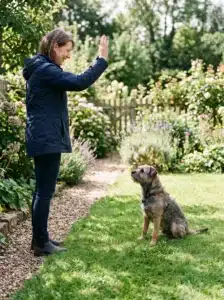
1. “Watch me”: the finger to the eyes
This is the master key. Bring two fingers up to your own eyes. When your dog makes eye contact, thumbs up, treat.
To teach it, hold a treat out to the side at arm’s length. Your dog will stare at the treat. Wait. The moment his eyes flick to your face instead, even for a heartbeat, mark it and pay. Dogs figure this out shockingly fast, and soon you can add the two finger gesture just before the eye contact happens. Practice until a single gesture pulls his gaze to your face anywhere in the house, and remember that signals, like spoken commands, need practicing in many locations before they work everywhere, the same generalization problem I ran into in why my dog ignores commands outside.
Why it matters so much: every other signal starts with this one. Watch me, then sit. Watch me, then come. It is the deaf dog’s version of hearing his name.
2. Sit: the rising palm
Flat palm facing up, starting at your waist, sweeping upward toward your shoulder. This mirrors the natural lure motion, food moving up over the nose, rear folding down, which is exactly how you teach it, the same gentle no-hands-on method I used in teaching an older rescue dog basic commands. Lure the sit with a treat a dozen times, then make the same motion with an empty hand. Most dogs never notice the treat is gone.
Max learned this in two short sessions, and he had never known a formal sit command in his life. Thirteen years old.
3. Down: the falling palm
Flat palm facing the floor, moving from chest height straight down. Again the signal is simply the lure motion, food drawn from nose to floor, made official.
A note for aging joints: teach down on a carpet or a folded blanket, never on tiles. If your senior dog is slow to lie down, it may be arthritis rather than confusion. Max needed a moment to arrange his back legs, so I learned to signal and then simply wait, palm held low, no repeating. The pause is part of respecting an old dog.
4. Stay: the traffic police hand
Palm pushed flat toward the dog’s face, held there. The universal stop gesture.
Teach it in tiny slices. Signal stay, count one second, thumbs up, treat. Then two seconds. Then you shift your weight backward. Then one actual step. With a deaf dog there is one extra wrinkle, he cannot hear you leave or return, so keep stays short at first and always come back to him to pay, rather than calling him out of the stay from a distance. Breaking a stay to follow you is not disobedience in a deaf dog. It is often anxiety about losing sight of you, and it fades as his confidence grows.
5. Come: the sweeping arm
Both arms opened wide, then swept inward across your chest, like an exaggerated hug pulling him toward you. Big enough to be seen across a garden.
Teach it indoors at three steps’ distance first. Signal, and the instant he moves toward you, flash the thumbs up while he is coming, then jackpot when he arrives, several small treats fed one by one. Add distance a meter at a time.
Important honesty here: a deaf dog’s recall only works when he is looking at you, and no signal works when a cat crosses the fence line. For this reason Max was never off leash in unfenced areas after his diagnosis, no exceptions. A long training line gave him freedom to sniff while the recall stayed a game we played inside the garden. Deafness does not shrink a dog’s life, but it does redraw one boundary, and pretending otherwise is how accidents happen.
6. “Free” or “all done”: both hands open
Dogs relax when they know a session or a stay is finished. Both hands open outward, palms up, like a shrug. Signal it, then release him with a happy face and maybe a toy toss. Without a clear “all done,” some dogs hold their stay long after you have wandered off to make tea, quietly stressed, waiting.
7. Dinner time: the pinched fingers to mouth
Fingertips bunched together and tapped toward your mouth. Honestly, you will not need to teach this one so much as announce it. Do the signal, put down the bowl. After three days Max would sprint to the kitchen from a dead sleep if the vibration of my footsteps woke him and he caught the gesture.
I include it because signals for happy everyday events do something bigger than convenience. They teach a newly deaf dog that watching you pays off constantly, which sharpens attention for everything else.
8. The gentle wake up: touch, not gesture
Not a hand signal, but essential. A deaf dog startled awake can snap before he even knows where he is, and nobody should be blamed for it, not the dog, not the child who touched him.
The kind way is to teach that being woken always predicts something lovely. While Max slept, I would place my hand softly on the mattress near him so the vibration stirred him, or gently touch the same spot on his shoulder, always the same spot, and the moment his eyes opened there was a treat in front of his nose. Within weeks, being woken made his tail thump before his eyes fully focused. If children live in your home, teach them the rule early: never touch the sleeping dog, call an adult instead.
Getting a Deaf Dog’s Attention From a Distance
The question everyone asks: how do you “call” a dog who cannot hear and is not looking at you?
Stomp on the floor. Wooden and tiled floors carry vibration surprisingly well, and most deaf dogs learn that the thump means look around, someone wants you. Pay generously every time he turns to find you and the stomp becomes reliable.
After dark, a small torch works wonders. Flick it on and off near him, never in his eyes, and reward the look. Max learned that the flicker at the garden door meant come inside, and on winter evenings it looked like we were exchanging secret codes across the lawn, which in a way we were.
Some owners use a vibrating collar, which gives a gentle buzz from a remote, nothing to do with shock collars, which have no place anywhere near a deaf or senior dog. We never needed one, the stomp and the torch covered everything, but for a young deaf dog with a big property they are worth researching.
The Mistakes I Made So You Do Not Have To
I trained too long. Ten minute sessions left Max visibly drained, because reading signals is concentration work for an old dog. Three minutes, twice a day, moved us faster than one long session ever did.
I changed my signals. Early on, my sit was sometimes a sweep and sometimes a point, depending on my mood. Pick one version of each signal, write them down, and make everyone in the house use the identical gestures. To a dog, your version and your husband’s version are two different languages.
I forgot he could still feel my mood. The first week after the diagnosis I was sad around him, moving carefully, hovering. Max read all of it and became clingy and unsettled. The day I went back to treating him like his normal ridiculous self, he settled too. Deaf dogs do not know they have lost something. They are not grieving. Only we are.
And one mistake I luckily avoided, thanks to our vet: assuming deafness explains everything. Sudden hearing loss, or hearing loss with head tilting, circling, or ear scratching, needs a proper examination, because infections and other treatable problems can look like age related deafness. Get the diagnosis confirmed before you retrain your whole life around it.
Old Dogs See More Than We Think
Max lived two more years after that vet visit, and I can say honestly that they were not lesser years. They might have been our best ones. Deafness forced us to look at each other constantly, and there is a strange intimacy in a dog who watches your face the way deaf dogs learn to.
On his last winter, my sister visited and watched me flash the dinner signal from across the room. Max levitated off his cushion and skidded into the kitchen, and she said, “I forgot he is deaf. He does not act deaf.” That is the whole point of this article. A deaf dog with hand signals does not act deaf. He acts fluent.
If your old friend has stopped hearing the cheese wrapper, do not mourn the ears. Start with the thumbs up and a pocket of treats tonight. Somewhere around the tenth repetition, when his eyes lock onto your hands and his tail starts going, you will realize the conversation between you never actually stopped.
It just changed languages.

























