
Large breed dogs get treated like they just need “more” of everything — more food, more protein, bigger portions. That’s not quite right, and it’s actually one of the more common mistakes people make when switching a big dog over to homemade meals. Large and giant breeds have some genuinely different nutritional considerations compared to smaller dogs, particularly around joint support and calorie density, and a homemade recipe that ignores those differences can cause real problems over time, especially during growth.
Let’s get into what actually matters for large breeds specifically, then a base recipe built around those needs.
Why Large Breeds Aren’t Just “Big Versions” of Small Dogs
The most important distinction, especially for growing large breed puppies, comes down to growth rate and joint development. Large and giant breed puppies grow explosively fast compared to small breeds, and feeding them a diet that’s too calorie-dense or has an imbalanced calcium-to-phosphorus ratio during this growth window is linked to a higher risk of developmental orthopedic issues, including hip dysplasia and other joint problems later in life.
This is genuinely one of the areas where “more protein, more calcium, grow big and strong” thinking backfires. Controlled, steady growth — not maximized growth — is what actually supports healthy joint development in large breed puppies. For adult large breed dogs, the concerns shift somewhat toward weight management and joint maintenance, since excess weight puts significantly more strain on joints already carrying a bigger frame.
What This Means for a Homemade Recipe
A few practical adjustments come out of those growth and joint considerations:
Moderate, not excessive, calorie density. Large breed meals shouldn’t be packed with extra fat and calories “because they’re big.” Lean proteins and controlled portions matter more than sheer volume.
Balanced calcium and phosphorus, especially for growing puppies. Too much calcium relative to phosphorus (or vice versa) during growth is specifically linked to skeletal development problems in large breeds.
Joint-supportive ingredients like those containing natural glucosamine and chondroitin — bone broth being a good, accessible source — can be a reasonable addition, particularly for adult and senior large breed dogs already managing joint wear.
Consistent portioning matters more here than with small breeds, since a proportionally small measuring mistake translates into a much bigger swing in total calories for a dog this size.
A Base Recipe for Adult Large Breed Dogs
This recipe is sized for a large adult dog (roughly 60-90 lbs) and makes enough for about 3 to 4 days, depending on exact size and activity level.
Ingredients:
- 3 lbs lean ground turkey or chicken
- 3 cups brown rice, uncooked
- 2 cups diced carrots
- 1 cup chopped spinach
- 1 cup peas
- 2 cups bone broth (homemade, no onion, garlic, or salt)
Method: Cook the rice separately according to package directions. In a large pot, cook the ground meat thoroughly until no pink remains, then add the carrots, spinach, and peas, letting everything simmer together for about 15 minutes. Combine with the cooked rice and bone broth, stirring until evenly mixed.
This ratio leans toward moderate protein with a solid vegetable and carbohydrate base rather than maximizing protein density, which fits better with the “steady, not excessive” approach that suits large breeds well, particularly for weight management in adult dogs.
A Note for Large Breed Puppies Specifically
If you’re feeding a large breed puppy rather than an adult, this is genuinely an area where I’d encourage working with your vet or a veterinary nutritionist rather than relying purely on a general recipe, even a well-intentioned one. The calcium-to-phosphorus ratio and overall calorie density needed for safe, controlled growth in large breed puppies is precise enough that getting it meaningfully wrong can have long-term consequences for joint health. A general homemade recipe built for adult maintenance isn’t automatically appropriate for a growing large breed puppy, and this is one of the clearer cases where professional guidance is worth the extra step, rather than an optional nice-to-have.
Portion Guidelines for Adult Large Breeds
As a general starting point, based on typical calorie needs:
- 60-70 lb dogs: roughly 3 to 3.5 cups per day, split across two meals
- 70-90 lb dogs: roughly 3.5 to 4.5 cups per day, split across two meals
- 90+ lb dogs: roughly 4.5 to 5.5 cups per day, split across two meals, adjusted further for very large or giant breeds
These are starting estimates, not fixed rules — activity level, age, and individual metabolism all shift the right amount for your specific dog. Regularly checking body condition (being able to feel, but not see, the ribs, with a visible waist from above) is a more reliable day-to-day guide than rigidly sticking to a cup measurement regardless of how your dog’s body actually looks.
Why Splitting Meals Matters More for Large Breeds
Large and giant breed dogs are at meaningfully higher risk for a serious condition called bloat (gastric dilatation-volvulus), particularly when eating one large meal quickly rather than smaller portions spread across the day. Splitting daily food into two meals rather than one large sitting is a commonly recommended practice specifically for large and giant breeds, partly for this reason. It’s worth discussing with your vet if your dog has any risk factors, since bloat is a genuine emergency requiring immediate veterinary care.
Storage for Larger Batches
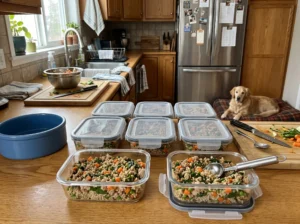
Because large breed dogs eat considerably more per meal than smaller dogs, batch cooking becomes more practical, and honestly, more necessary just from a time-management standpoint.
Refrigerator: Up to 4 days in a large, sealed container.
Freezer: Portion into daily or meal-sized containers and freeze for up to 3 months. Given the volume involved, this is where a lot of large-breed owners end up relying more heavily on freezer storage than owners of smaller dogs might need to.
Joint Support Beyond the Food Itself
While a well-balanced homemade diet with bone broth and appropriate calorie levels supports general joint health, it’s worth knowing that a homemade diet alone typically isn’t a substitute for targeted joint supplements if your large breed dog already has diagnosed joint issues or is at a life stage where extra support is recommended. Glucosamine and chondroitin supplements, prescribed or recommended by your vet, often work alongside a good diet rather than being replaced by it.
Final Thoughts
Feeding a large breed dog well through homemade meals isn’t really about scaling up a small-dog recipe — it’s about paying attention to the specific things that matter more for bigger frames: controlled growth in puppies, joint-conscious ingredients for adults, careful portioning given how much a measuring mistake can add up, and meal-splitting to reduce bloat risk. Get those pieces right, and homemade feeding can genuinely support a large breed dog’s health through every life stage, from an actively growing puppy to a senior dog managing the wear that comes with carrying a bigger body for years.
Adjusting the Recipe for Senior Large Breed Dogs
Large breeds tend to reach their senior years earlier than smaller dogs, often somewhere around 6 to 7 years old rather than the 10-plus mark that smaller breeds reach before being considered senior. This earlier transition matters for homemade feeding because calorie needs typically decrease as activity level drops, while joint support becomes an even bigger priority.
For a senior large breed, consider reducing the lean protein slightly while increasing the bone broth ratio, since broth adds joint-supportive collagen without significantly increasing calorie density. Softer-cooked vegetables, cooked a bit longer than in the adult recipe, can also make meals easier to manage for senior dogs who may be dealing with dental wear or reduced chewing comfort.
Common Mistakes Worth Avoiding
A few patterns show up often enough with large breed homemade feeding that they’re worth flagging directly. Overfeeding “because they’re big” is probably the most common one — a large dog’s calorie needs don’t scale up as dramatically as their size suggests, especially for less active large breeds who aren’t working dogs or particularly high-energy.
Skipping the bone broth or joint-supportive ingredients entirely is another frequent gap, often just because people don’t realize it’s particularly relevant for their breed until joint issues show up later. And inconsistent portioning — eyeballing servings rather than measuring — tends to cause bigger swings in a large dog’s weight over time simply because the margin for error scales up along with the dog.
When to Loop In Your Vet
Beyond the puppy-specific guidance already mentioned, it’s worth checking in with your vet any time you’re making homemade food the primary diet for a large breed dog long-term, rather than an occasional addition to commercial food. They can help confirm the overall nutrient balance holds up over months and years, flag any breed-specific concerns (some large breeds have known predispositions to particular joint or heart conditions that are worth factoring into diet decisions), and adjust recommendations as your dog moves through different life stages. A homemade recipe built with general large-breed principles in mind is a strong starting point, but ongoing check-ins keep it genuinely appropriate for your specific dog over time.

























