The day I found my television remote in three pieces, I was angry. The day I found a small white tooth stuck in my slipper, I panicked and called the vet convinced something terrible had happened to my puppy.
The receptionist laughed. Not unkindly, but she definitely laughed. “Congratulations,” she said. “Simba is teething. Keep the tooth if you want, most people never find one.”
Nobody had warned me that puppies lose teeth like children do. Nobody warned me about the blood spots on rope toys, the week he refused his kibble, or the month my ankles became his favorite snack. I went into puppy teething blind, and it turned my home into a crime scene of destroyed chargers and chewed chair legs.
So this is the article I needed back then: a plain, month by month map of what happens inside your puppy’s mouth during his first year, what is normal, what is not, and how to get through it with your furniture and your sanity mostly intact. I raised Simba through every stage below, and I will tell you honestly which parts were easy and which parts nearly broke me.
The Quick Picture Before We Start
Puppies grow two full sets of teeth in under eight months. The baby set, 28 tiny needle sharp teeth, arrives in the first weeks of life. Then, starting around three to four months of age, every single one of those baby teeth falls out and 42 adult teeth push through to replace them.
Read that again. Forty two teeth erupting through sore gums in a few months. When people ask me why puppies chew everything, that is the answer. It is not naughtiness. It is a mouth full of construction work, and chewing is the only pain relief a puppy knows.
Now the timeline.

Weeks 2 to 4: The First Needles Appear
You will probably never see this stage unless you are raising a litter, because puppies are still with their mother. The first baby teeth, the tiny front incisors and the fang like canines, begin poking through at around two to three weeks of age.
If you ever wondered why mother dogs start walking away from nursing sessions around week four or five, those needle teeth are the reason. Nature designed baby teeth to be uncomfortable for the mother on purpose. It is the beginning of weaning, the push toward solid food.
What you need to do at this stage: nothing, unless you are the breeder. But it is worth knowing, because it explains something important later on. Those teeth are sharp by design, and they stay that way.
Weeks 5 to 8: A Full Mouth of Pins
By the time a puppy is ready to come home at eight weeks, all 28 baby teeth are usually in place. Twelve incisors at the front, four canines, and twelve premolars along the sides. Interestingly, puppies never grow baby molars. The big back grinding teeth only come with the adult set.
This is the mouth that greets you when you bring your puppy home, and I can confirm from experience that those 28 pins are fully operational. Simba’s play bites in week nine left marks on my hands that had visitors asking if I owned a cat.
What is normal: mouthing everything, including you. Puppies explore the entire world through their mouths the way human babies grab everything within reach. What to do: start teaching bite inhibition right now, from day one. Every time those needles touch skin during play, I gave a sharp little “ow,” stopped the game, and turned away for ten seconds. Play resumes only when teeth stay off skin. It feels like it is not working for weeks. Then somewhere around month four, you realize the mouthing has gone soft, and eventually it disappears. Puppies taught this early grow into adults with gentle mouths, and it is far easier to teach now than later.
Months 3 to 4: The Great Tooth Fall Begins
Somewhere around twelve to sixteen weeks, the real teething starts. The baby incisors at the front loosen first, and adult incisors push up underneath them.
Here is what surprised me most: you will rarely see the teeth fall out. Puppies swallow most of them during meals or play, which sounds alarming and is completely harmless. Finding an actual tooth, like my slipper discovery, is luck. Check your puppy’s favorite chew toys and bedding if you want a keepsake for the puppy album.
The signs teething has started:
Small blood smears on toys. This one frightens new owners badly, and I want to reassure you, a few pink or red spots on a rope toy are completely normal. A loosening tooth bleeds a tiny bit, the same as a child’s wobbly tooth.
Drooling more than usual, sometimes with a slightly metallic smell to the breath. Teething breath is a real thing and it is strange, somewhere between sour milk and old coins. It passes.
Chewing that suddenly doubles in intensity. Week thirteen was the week Simba stopped chewing his toys and started chewing my house. Skirting boards, table legs, one corner of the carpet, and the famous remote. His gums hurt and anything with resistance felt good against them. One more thing worth checking during a destructive phase: whether your puppy is actually getting enough naps, because an overtired puppy chews harder and wilder than a rested one, something I explain fully in how much sleep a puppy actually needs at each age.
Eating more slowly, or dropping kibble. A puppy with loose front teeth sometimes finds hard food genuinely painful. Simba would pick up a piece of kibble, drop it, look at it with betrayal, and try again with the other side of his mouth.
What actually helped at this stage: I soaked his kibble in warm water for ten minutes to soften it during the worst weeks. I also discovered the single greatest teething hack I know: the frozen wet cloth. Take a clean cotton cloth or small towel, soak it in water, wring it out, twist it into a rope shape and freeze it. The cold numbs sore gums and the texture satisfies the chewing urge. Simba would work on a frozen cloth for twenty minutes and then sleep like a stone. Rotate two or three so a fresh one is always in the freezer, and take the cloth away once it thaws and starts shredding.
Months 4 to 5: Peak Chaos
I will not sugarcoat this. Months four and five were the hardest stretch of Simba’s entire puppyhood, and if you are in this stage right now reading this at midnight next to a chewed phone charger, I see you.
This is when the canine teeth, those long fangs, begin loosening and the adult canines push through, along with the premolars further back. The canines have deep roots and their replacement seems to be the most uncomfortable part of the whole process. Simba was clingy, whiny in the evenings, and possessed by the spirit of a woodchipper.
Two things saved my furniture:
First, management instead of hope. I stopped expecting a teething puppy to make good choices and started removing the choices. Shoes went inside cupboards, wires went behind furniture or into cable covers, and when I could not supervise him, Simba stayed in a puppy proofed room with only legal chewing options available. People sometimes feel this is giving up on training. It is not. You cannot train a puppy out of teething any more than you can train a baby out of crying. You manage the environment until the phase passes, and it does pass.
Second, the trade game. When I caught him with something forbidden, I never chased him and never pulled it from his mouth. Chasing teaches a puppy that stealing objects starts a brilliant game, and pulling things away teaches him to guard them. Instead I would fetch something better, a treat or a favorite toy, offer the swap, and praise him for releasing. By month six, Simba was voluntarily bringing me his stolen treasures to trade, which was ridiculous and adorable and much cheaper than replacing remotes.
One warning for this stage: check the canines occasionally. Sometimes an adult canine erupts while the baby canine refuses to fall out, so the puppy briefly has two fangs side by side in the same spot. A double tooth that resolves within a week or so is usually fine. One that persists needs a vet visit, because retained baby teeth trap food, push adult teeth out of position, and can cause bite problems for life. Small breeds like poodles, Yorkies and Chihuahuas are especially prone to this, so watch their mouths closely.
Months 5 to 7: The Molars and the Finish Line
The last arrivals are the big molars at the very back, the grinding teeth that never had baby versions. Most puppies have their complete adult set of 42 teeth somewhere between six and seven months, though larger breeds sometimes run a little later.
You will notice the chewing urge fades gradually rather than switching off. Simba’s furniture attacks stopped around month six, but he stayed an enthusiastic chewer of legal items well past his first birthday, and honestly, dogs who enjoy a good chew stay that way for life. The difference is that an adult dog with an adult mouth chews his own toys, not your table.
What to do now: this is the perfect moment to build a tooth brushing habit, because the adult teeth coming in are the only teeth your dog will ever have again, and they need to last twelve or fifteen years. I started by just letting Simba lick dog toothpaste off my finger, then off a finger brush, a few seconds at a time. Never use human toothpaste, it contains ingredients dogs must not swallow. A dog who learns at seven months that brushing predicts a treat will tolerate it forever. A dog introduced to brushing at seven years will fight you like you are performing surgery.
When Teething Is Not the Problem: Call the Vet If You See These
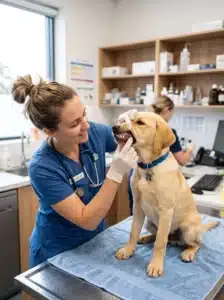
Most teething is uneventful, but a handful of signs mean a professional needs to look:
A puppy who stops eating entirely for more than a day, rather than just eating slowly or fussily. Sore gums cause picky eating, not full refusal.
Swelling on the face or along the jaw, a broken or grey colored tooth, or bleeding that is more than light smearing on toys.
Double teeth, especially double canines, that stick around longer than a week or two after the adult tooth is fully through.
An adult tooth coming in at a clearly wrong angle, poking the lip or the roof of the mouth.
Breath that goes beyond the odd metallic teething smell into genuinely foul territory, which can signal infection.
None of these happened to Simba, but our vet checked his bite alignment at every vaccination visit anyway, which took her about ten seconds each time. Ask yours to do the same, it is exactly the kind of question worth writing down before an appointment, and my first vet visit checklist for new puppy owners covers the full list. Problems caught during eruption are simple to fix, and the same problems discovered at two years old are expensive.
The Part Nobody Tells You
Somewhere around Simba’s seventh month, I realized the chewing chaos had quietly ended and I had not even noticed the last day of it. The frozen cloths stayed in the freezer unused. The cable covers came off. The remote, the third remote, survived.
What I am left with, four years later, is a small plastic box containing one tiny white canine tooth I found in a slipper, and a dog with a strong healthy adult mouth who still brings me things to trade when he wants attention.
Teething feels endless while you are inside it. It is actually one of the shortest phases of your dog’s life, roughly four months of real disruption, and every stage of it is your puppy’s body doing exactly what it is supposed to do. Freeze the cloths, hide the wires, trade instead of chase, keep an eye out for double fangs, and take photos of that ridiculous gap toothed grin around month four.
You will miss it. I am not joking. You will genuinely miss it.