Everyone warned me not to adopt Bella.
She was somewhere between six and eight years old, nobody at the shelter knew for sure. She flinched when hands moved too fast near her face. She had clearly never lived inside a house, because stairs confused her and the ceiling fan was, in her opinion, a predator. The shelter volunteer was honest with me. “She is sweet,” she said, “but she knows nothing. Not sit, not her name, nothing. Most people want a dog that is already trained.”
I took her home anyway. And over the next eight months, this middle aged, nervous, completely untrained dog learned sit, down, stay, come, and to walk politely on a leash. No shouting was involved. No leash jerks. No dominance nonsense. Mostly it involved cheese, patience, and me learning to slow down to her speed instead of dragging her up to mine.
If you have just brought home an older rescue and you are staring at each other wondering where to even begin, this article is the one I wish someone had handed me on day one.
First, Throw Out the Puppy Rulebook

Almost everything written about dog training assumes you have a blank slate puppy. An adult rescue is not a blank slate. She is a full notebook, written in a language you cannot read, and some of the pages are torn.
Bella was not “untrained” in the way a puppy is untrained. She had been trained by life, just not in anything useful to me. Life had taught her that fast hands mean danger, that men in caps are frightening, that food might disappear if she does not gulp it, and that new places should be scanned before entering. Those lessons were burned in deep.
This is the single most important mindset shift for rescue owners: before your dog can learn from you, she has to unlearn her fear of you. Training and trust building are not two separate projects. With a rescue, they are the same project, and trust comes first every single time.
The good news, and I mean genuinely good news, is that the old saying about old dogs and new tricks is rubbish. Adult dogs actually have longer attention spans than puppies. They are calmer, they are not teething, and they are not fighting a hurricane of puppy hormones. Once Bella felt safe, she learned faster than any puppy I have known. The hard part was never her ability. It was the fear sitting in front of it.
The Two Week Do Nothing Phase
Here is what our first two weeks of “training” looked like: nothing.
No commands. No expectations. I did not even try to teach her name. I fed her, walked her at quiet hours, sat on the floor in the same room while she watched me from her corner, and tossed the occasional treat in her direction without looking at her. That was it.
Rescue people call this decompression, and I nearly skipped it because it felt like wasted time. It is the opposite. A dog fresh out of a shelter is running on stress hormones, and a stressed brain cannot form new memories properly. Any training you attempt during this window is not just useless, it can attach your voice and your presence to her anxiety. You become part of the scary new world instead of the safe spot inside it.
I knew the phase was ending when three things happened. Bella started eating with me in the room instead of waiting for me to leave. She began sleeping stretched out on her side instead of curled in a tight ball. And one evening she walked over, sniffed my knee, and sat down near me by her own choice.
That sit, the one nobody asked for, was worth more than any command I taught her later.
How I Taught Each Command, In the Order That Worked
Her name came before everything
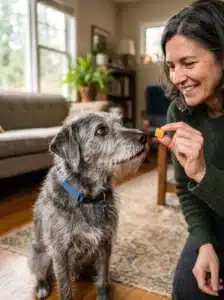
Bella did not know she was Bella. So several times a day, whenever she happened to glance at me, I said “Bella” in a warm voice and immediately gave her a tiny piece of chicken. I was not asking for anything. I was just paying her for the glance and attaching a sound to it.
Within a week, the sound of her name made her head turn. Within two, it made her tail move. That is the foundation of everything else, because a dog who happily turns toward her name is a dog you can actually talk to.
One warning from experience: never use her name for anything unpleasant. Not for baths she hates, not for scolding, not for ending fun at the park. The name has to stay golden. I made this mistake exactly once, calling her sweetly and then clipping her nails, and it cost me a week of suspicion.
Sit, without ever pushing her down
You will read advice telling you to push the dog’s rear down. Please do not do this with a rescue. A dog with an unknown history may have been grabbed, and hands pressing on her body can undo weeks of trust.
Instead I used a piece of cheese like a magnet. I held it just above her nose and moved it slowly back over her head. Her nose followed it up, and physics did the rest, her back end folded into a sit on its own. The instant it touched the floor, she got the cheese and a soft “good girl.”
I did not say the word “sit” at all for the first twenty or thirty repetitions. This surprises people, but there is no point naming a behavior the dog cannot do yet. Only when the cheese magnet was producing a sit every single time did I start saying “sit” just before her rear touched down. The word attached itself to the movement, and within days I could say it without any cheese in my hand at all. One thing to know in advance: a sit learned in your living room will not automatically work at the park, dogs do not transfer commands between locations easily, and I have explained that whole puzzle in why my dog ignores commands outside.
Down, the command fear gets in the way of
Down took Bella longer than everything else combined, and I want to prepare you for the same, because there is a reason behind it. Lying down is a vulnerable position. A dog who has had hard experiences does not offer her belly to the world easily, and no amount of repetition fixes that. Only safety fixes it.
We practiced on her bed, the one place she fully relaxed, using the same food magnet trick, this time luring her nose down between her front paws. The first week I rewarded her for just lowering her head. The second week, for bending one elbow. I was paying for installments, not the full behavior. Trainers call this shaping, and for nervous dogs it is everything.
The day she finally slid into a full down, she popped straight back up like the floor had shocked her. I laughed, paid her generously, and we ended the session right there. Always end on the win.
Stay, taught in seconds, literally
My early mistake with stay was being greedy. I asked for ten seconds when Bella could give me two, she broke the stay, and we both got frustrated.
The fix was counting in my head and only asking for what she could already do. Two seconds, reward. Two seconds, reward. Ten repetitions, then three seconds. It felt painfully slow and it built a stay that never broke. Distance came only after duration was solid, and I mean one single step back, then return and pay. If she broke the stay, that was my information, not her disobedience. It meant I had asked for too much too soon, and the next repetition I made easier.
Come, the command that saved her life once
Recall for a rescue starts in the hallway, not the park. I would wait until Bella was mildly occupied, say “Bella, come!” in the happiest voice I own, and the moment she arrived, she hit a jackpot. Not one treat. Five or six tiny ones, fed one after another, plus praise, plus sometimes a little game.
The jackpot matters. Coming when called has to be the best deal in your dog’s entire life, better than smells, better than cats, better than the open gate. A year after adoption, a delivery driver left our gate open and Bella wandered onto the road. I called her once. She turned and ran back to me past a motorbike. Every hallway repetition, all those months, was for that one moment.
Reading Stress Before It Becomes a Problem
The subtitle of this article says without stress, so let me be specific about what stress looks like, because rescue dogs rarely announce it loudly. Bella never growled or hid during training. Her signals were quieter: licking her lips when no food was around, yawning out of nowhere, turning her head away from me, suddenly becoming very interested in sniffing the floor, or a kind of slow motion quality to her movements.
For months I mistook that floor sniffing for distraction. It is not. It is a dog politely saying the lesson is too hard right now. When you see these signs, the answer is never to push through. End the session with one easy win, something she already knows, and try again later with a smaller ask.
My sessions with Bella were three to five minutes long, two or three times a day. That is all an older nervous dog needs. Ten good repetitions beat fifty tense ones every time, and short sessions meant she was always a little disappointed when we stopped, which kept her eager for the next one.
Questions I Get Asked About Training Older Rescues
Is she too old to learn? No. Age slows the body, not the willingness. If your dog can enjoy food or a toy, she can learn. Bella was learning new tricks at ten just to keep her mind busy. For very senior dogs, keep sessions shorter and skip anything hard on the joints, like repeated downs on hard floors.
How long until she is fully trained? Longer than a puppy for trust, often shorter for the actual commands. Bella needed two months before real training could even begin, then picked up five commands in roughly four months of relaxed practice. Every dog’s history writes a different schedule. Compare your dog to who she was last month, never to other dogs.
What if she was abused and fears my hand signals? Change the signals. There is no law saying sit must come with a raised palm. Bella feared overhead hand movements, so all my cues happen at waist level. Train the dog in front of you, not the one in the manual.
Should I use a clicker? I tried. The click sound scared Bella in the beginning, which is common with noise sensitive rescues. A soft marker word like “yes” did the same job without the startle. If your dog likes the clicker, great. If not, your voice is enough, and for dogs with hearing trouble a visual marker works beautifully, exactly as described in my guide to hand signals for deaf and aging dogs.
When should I get professional help? If your dog freezes completely during any training, guards food or toys with growling, or panics when left alone, bring in a qualified force free trainer or ask your vet for a behaviorist referral. These issues sit outside basic obedience, and the earlier they are addressed, the easier they are. There is no shame in it. I consulted a trainer twice for Bella’s fear of men in caps, and her advice saved us months.
What Bella Actually Taught Me
Bella is eleven now. She sleeps through thunderstorms that once sent her scrambling under the bed, walks past men in caps without a second look, and performs her little repertoire of commands for anyone holding cheese, which in her opinion is what guests are for.
But the thing I am most proud of is not the obedience. It is that somewhere in those eight months, training stopped being something I did to her and became something we did together. She started dragging me toward our practice spot in the garden. Learning had become safe, and once learning is safe, an older dog will surprise you every single week.
So if you have just adopted a nervous, untrained, past her prime dog and the internet is full of bouncing puppies making you feel behind, let me tell you what the shelter volunteer could not have known: the dog who knows nothing is also the dog who has never been taught that trying is dangerous. Go slow. Pay well. Ask small. Celebrate everything.
She is not behind. She is just beginning.